

Private Pilot Maneuvers · Crosswinds

Crosswind Landings, Forward Slips And The Crosswind Component

The crosswind component is the wind speed multiplied by the sine of the angle between the wind and the runway, so a 20-knot wind 30 degrees off the runway puts 10 knots across it. You land in that with the wing-low method, and you lose extra height with a forward slip, task IV-M in the Private Pilot ACS.

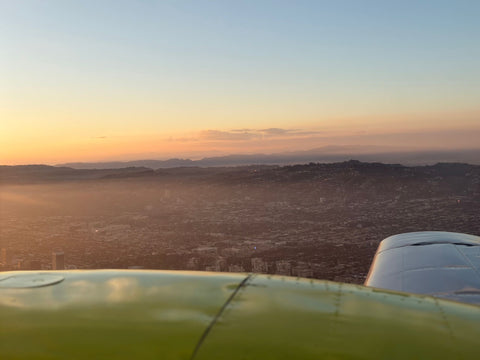
2Parallel runways at Van Nuys
0.5Sine of 30°: half the wind is crosswind
IV-MPrivate ACS task: forward slip
$349Two-hour first lesson, all-in
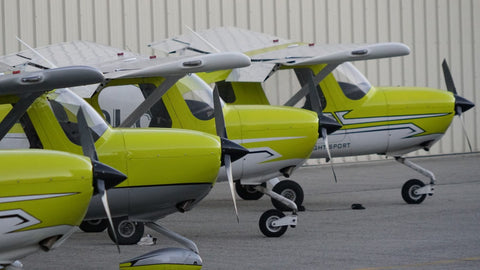
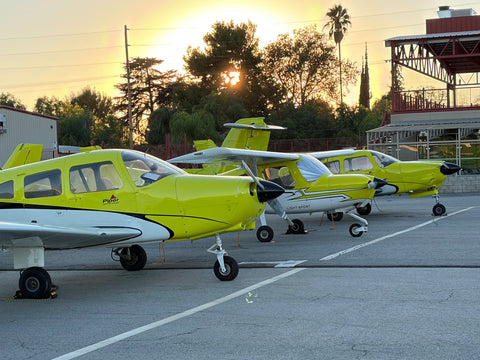
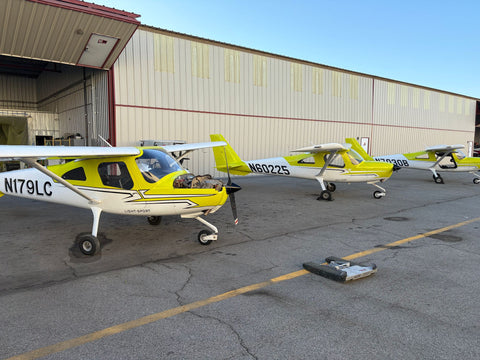
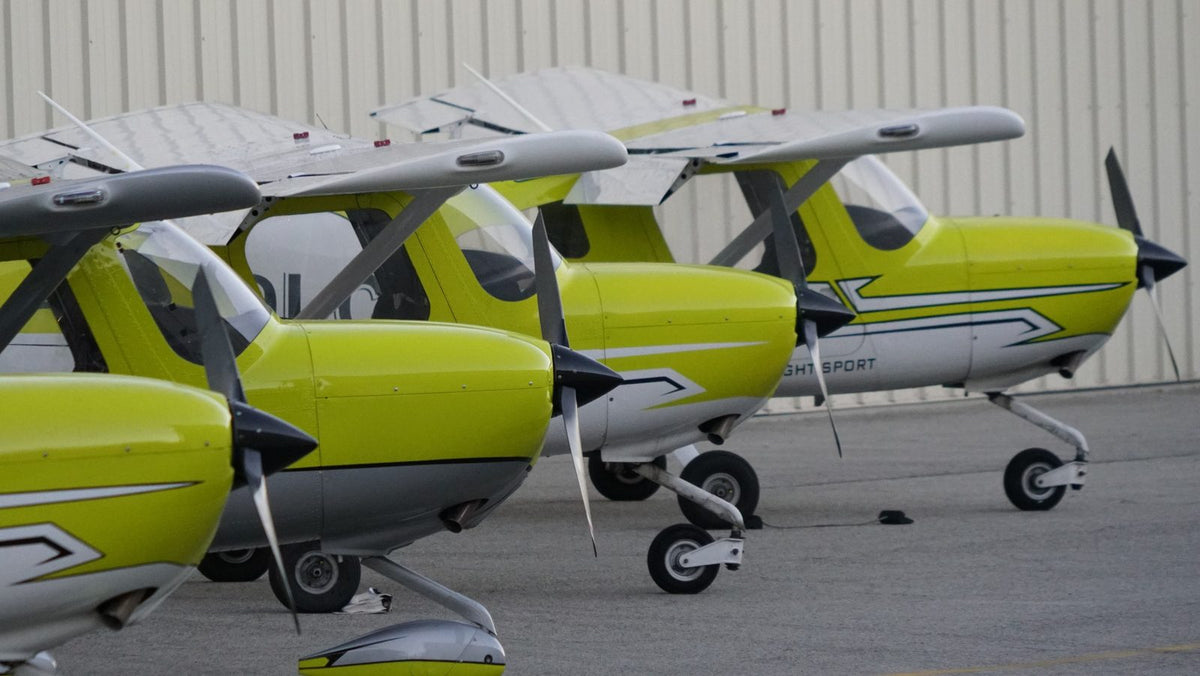
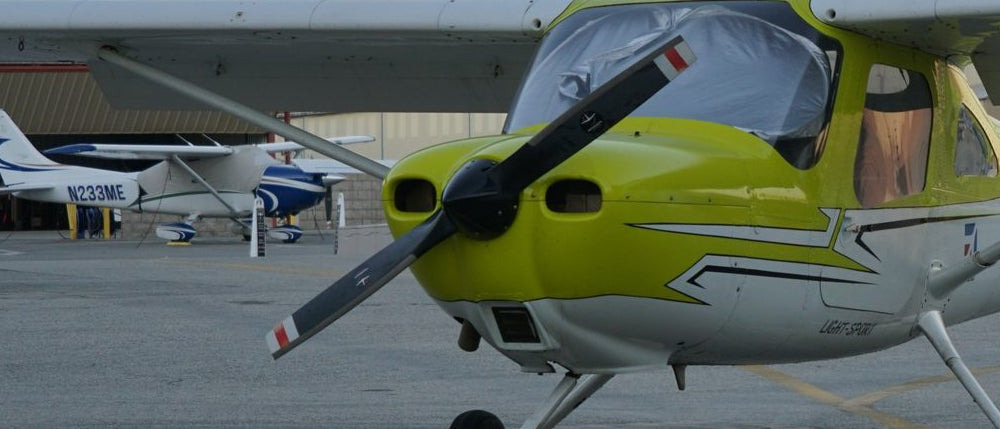
Noses and propellers of Cessna 162 Skycatcher trainers lined up outside a hangar at Van Nuys

Both skills come early. Under 14 CFR 61.87(d), your instructor has to train you in normal and crosswind takeoffs and landings, and in slips to a landing, before your first solo flight. On the checkride they sit in Area IV of the Private Pilot ACS beside the short-field and soft-field tasks, part of the full set of private pilot maneuvers an examiner can ask for. Every standard below comes from the FAA; the numbers for a particular airplane live in its POH, and we leave them there.

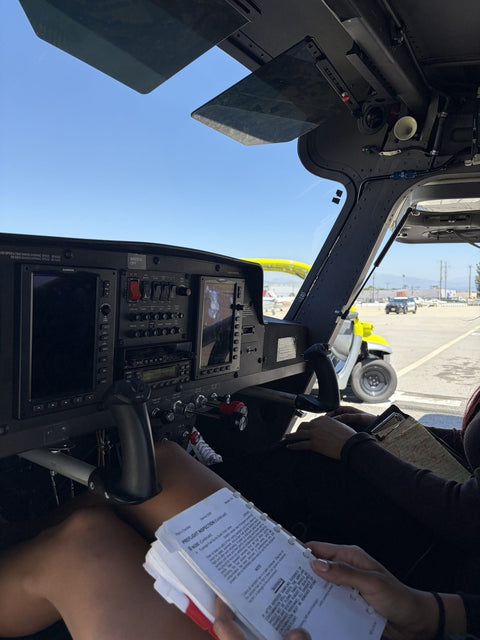
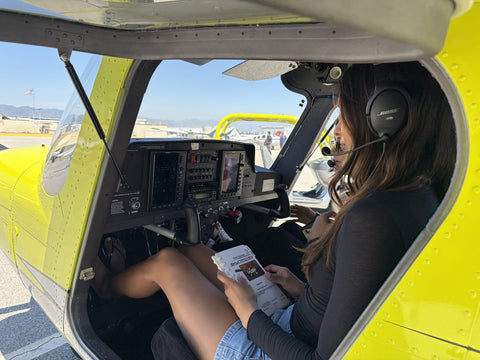
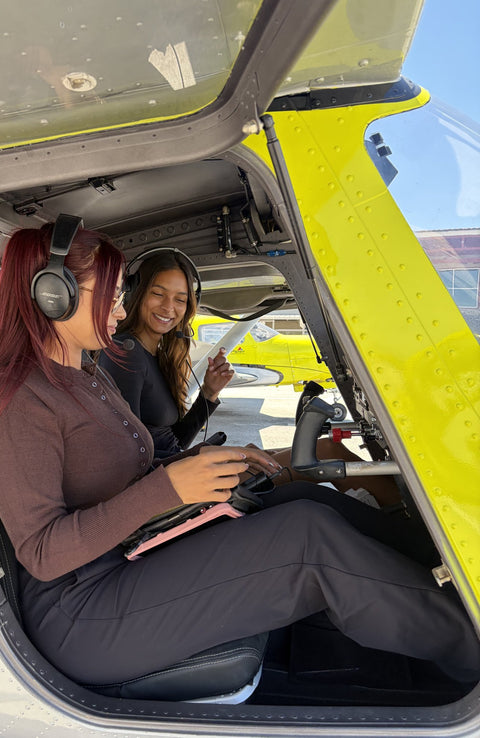
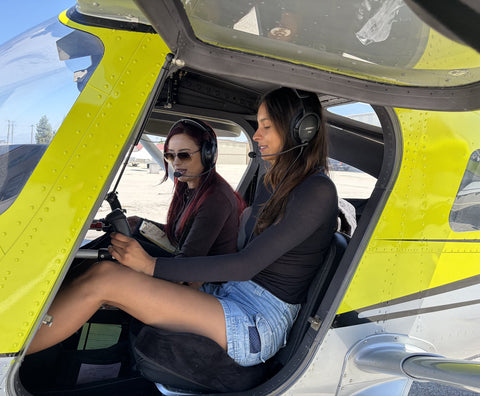
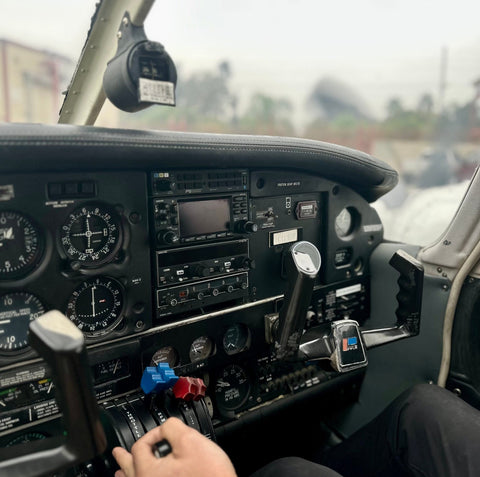
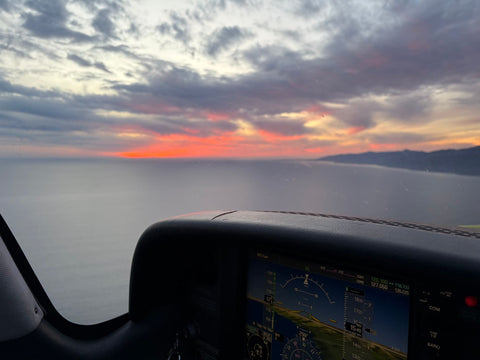
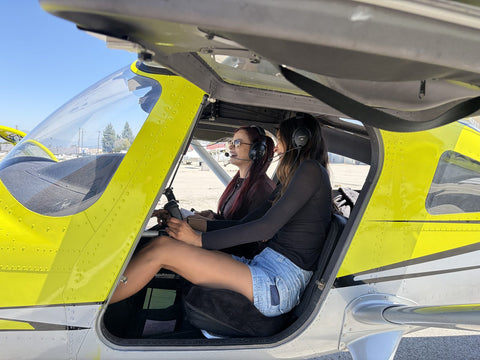
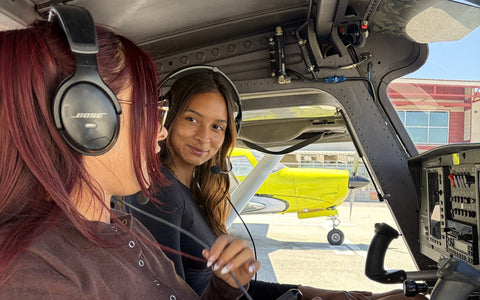
Instructor and student side by side in a training airplane cockpit, both wearing headsets

What A Crosswind Does To A Landing

Any wind that is not straight down the runway has two parts. The headwind part slows your groundspeed. The crosswind part pushes the airplane sideways across the ground. Left alone, it drifts you off the centerline on final, and if you touch down while still drifting, the landing gear takes a side load. The Airplane Flying Handbook (FAA-H-8083-3C, chapter 9) calls those loads damaging, and every landing task in the ACS asks for a touchdown with no side drift and the airplane's longitudinal axis aligned with the runway.

The fix is to bank or point the airplane into the wind just enough to cancel the drift, then hold that correction to the ground and through the rollout. Takeoffs need it too: the AFH has you start the roll with full aileron into the wind and hold the upwind wing down just after liftoff, so the airplane does not skip sideways.

You feel a crosswind in the seat before you see it on any instrument. A $229 discovery flight gives you 60 minutes at the controls from the left seat at Van Nuys, with an instructor beside you. It is credited in full toward training if you enroll within 24 hours.

How To Work Out The Crosswind Component

The FAA prints a chart for this in the Pilot's Handbook of Aeronautical Knowledge (FAA-H-8083-25C, chapter 11). Its worked example is runway 17 with the wind from 140 degrees at 25 knots: a 30-degree angle, a 22-knot headwind and a 13-knot crosswind. The chart is doing trigonometry, and you can do the same sum in four steps. The wind side of an E6B flight computer works it the long way.

Step 1 of 4

Read The Wind

Take the direction and speed from the ATIS or the tower, gusts included. The AIM notes that ATIS, and ASOS and AWOS voice broadcasts, report wind direction relative to magnetic north, the same reference the runway numbers use. Forecast winds aloft are referenced to true north (AIM 7-1-5), so they are the wrong input here.

Step 2 of 4

Find The Angle To The Runway

Under AIM 2-3-3, a runway number is the magnetic direction of its centerline divided by ten and rounded, so runway 16 points about 160 degrees. Subtract the smaller direction from the larger. Say the wind is 190 degrees at 20 knots and you are landing on runway 16R: the angle is 30 degrees.

Step 3 of 4

Multiply By The Sine

Crosswind equals wind speed times the sine of the angle; headwind uses the cosine. Four sines cover most days: 30 degrees is 0.5, 45 is about 0.71, 60 is about 0.87 and 90 is 1. Wind 190 at 20 on runway 16 gives 20 × 0.5, or 10 knots of crosswind, and about 17 knots of headwind.

Step 4 of 4

Compare It With Your Limit

Run the sum again with the gust speed, because the gust is what you will be holding off in the flare. Then set the answer against two numbers: the maximum demonstrated crosswind in the POH of the airplane you are flying, and your own limit. If the crosswind is above either one, the answer is another runway, another airport or another day.

The Wing-Low (Sideslip) Method

The AFH recommends this method in most cases, and it is the "side slip" the ACS asks you to change to before touchdown at the end of a forward slip. On final, use rudder to line the nose up with the runway. Lower the upwind wing with aileron until the drift stops. The ground track and the longitudinal axis now both run straight down the centerline. If the wind picks up, you need more bank and more opposite rudder; if it eases, take some out.

Keep the upwind wing down through the round out, so the first touchdown is on the upwind main wheel. During the rollout, keep feeding in aileron toward the wind; the handbook has it held fully toward the wind as the airplane stops. Our page on airplane controls explains what the ailerons and rudder are doing.

The handbook also sets the limit of the method. If the bank you need is so steep that full opposite rudder will not stop the airplane turning, the wind is too strong to land safely on that runway in those conditions.

It takes repetition with an instructor beside you. If you have not started training, a two-hour first lesson is $349, airplane and instructor included, from our ramp at Van Nuys.

The Crab Method And Why The Handbook Prefers Wing-Low

In a crab, you turn the nose into the wind with the wings level, so the airplane tracks the centerline while pointing slightly off it. It is the same wind correction you practice at altitude in ground reference maneuvers, and it is easy to hold on final. The trouble comes at the end. The crab has to come out the instant before touchdown, with rudder, and the AFH says that "requires judgment and precise timing." Take it out early and the airplane starts to drift. Take it out late and it lands pointing one way while moving another.

The wing-low correction is set up early on final and needs no heading change in the last second before touchdown, which is why the handbook recommends it in most cases. It still says "pilots should learn to do both," and it allows a combination of the two. The ACS wording is "appropriate crosswind correction" and a touchdown with no side drift. It does not name a method. And if checkride day is calm, a note in the normal takeoff and landing tasks has the evaluator test your crosswind knowledge orally instead.

Already a student pilot and fighting crosswinds? Book a free consultation at Van Nuys. It takes about half an hour and costs nothing. Bring your logbook and you will leave knowing which step comes next.

Awesome flight experience over LA! The instructions are awesome and the way they conduct the flights out of Van Nuys are very professional and informative. Awesome time!

★★★★★Adam S.Google ReviewRead More Reviews

The Forward Slip To A Landing

In the AFH's words, a forward slip "is used to dissipate altitude and increase descent rate without increasing airspeed." It is the answer to arriving on final too high, when pushing the nose down would only add speed you then have to lose.

To enter it, lower one wing with aileron and apply opposite rudder, so the airplane keeps its original path while the nose swings off to one side. It now moves slightly sideways through the air, drag rises, and it comes down steeply without gaining speed. To recover, level the wings and release the rudder together, then set the normal glide attitude. On a landing, take the slip out as the round out begins.

One caution from the handbook: airspeed indicators in some airplanes show considerable error in a slip, so fly the attitude and do not chase the needle.

Task IV-M asks you to plan a path to the landing area with altitude, wind, terrain and obstructions in mind, fly the downwind parallel to the runway, and configure the airplane. In a crosswind, you match the direction of the slip to the wind, upwind wing low, and change to a sideslip before touchdown. The touchdown standard is within 400 feet beyond or on the specified point, with no side drift and the longitudinal axis aligned with and over the runway center or landing path.

Sideslip Vs Forward Slip, Side By Side

The control inputs look alike: a lowered wing and opposite rudder. What differs is where the nose ends up and what the slip is for.

Sideslip Vs Forward Slip
Point Of Comparison Sideslip Forward Slip
Purpose Cancel crosswind drift so the airplane tracks the centerline Lose altitude and steepen the descent without gaining airspeed
Control Inputs Upwind wing lowered with aileron, just enough opposite rudder to stop a turn One wing lowered with aileron, opposite rudder to hold the original flight path
Where The Nose Points Straight down the runway Off to one side of the flight path
Flight Path Along the runway centerline, with the airplane moving toward the low wing just enough to cancel the drift Unchanged from before the slip
When You Use It Crosswind final approach, round out and touchdown High on final, taken out at the round out
ACS Task The crosswind correction in the normal, soft-field and short-field landings (IV-B, IV-D, IV-F) IV-M, which ends with a change to a sideslip in a crosswind

The sideslip is a crosswind tool and the forward slip is a height tool. On a windy day with a high final you can use both on the same approach.

Land It With An Instructor

Book A Lesson Or A First Flight

Lessons from $349, a $229 discovery flight, or the $249 simulator lesson that no wind can cancel. Free rescheduling up to 24 hours before, and if the weather says no, you do not pay.

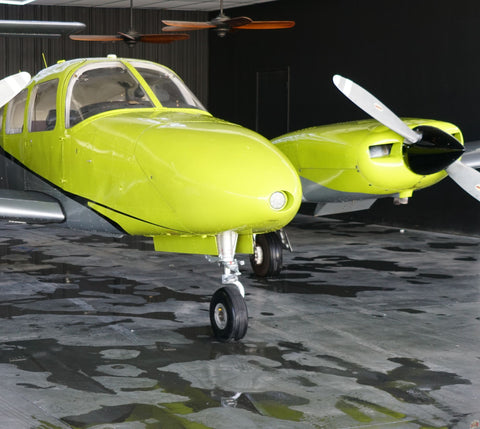
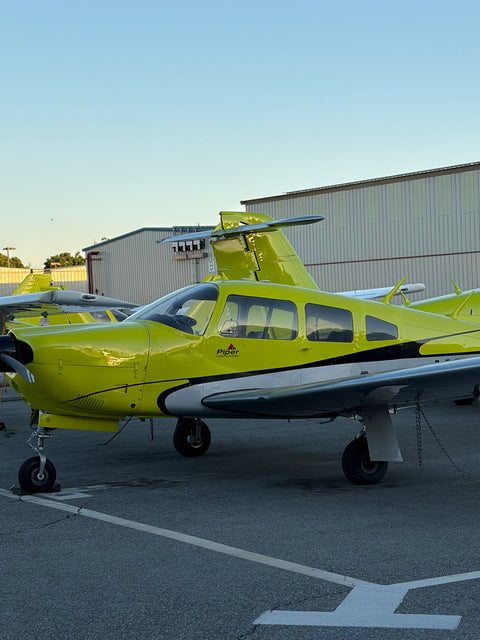
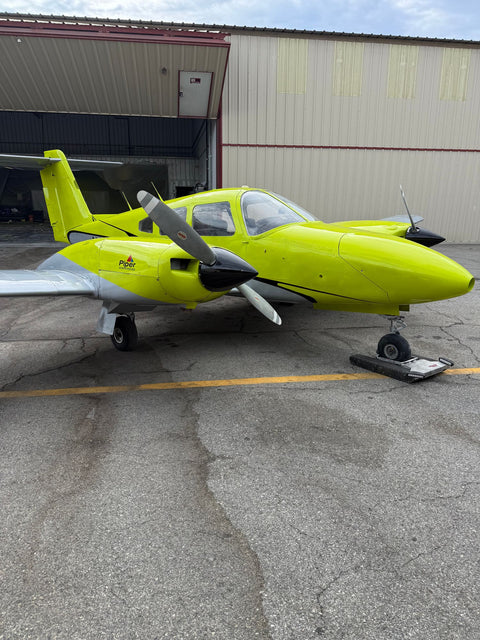
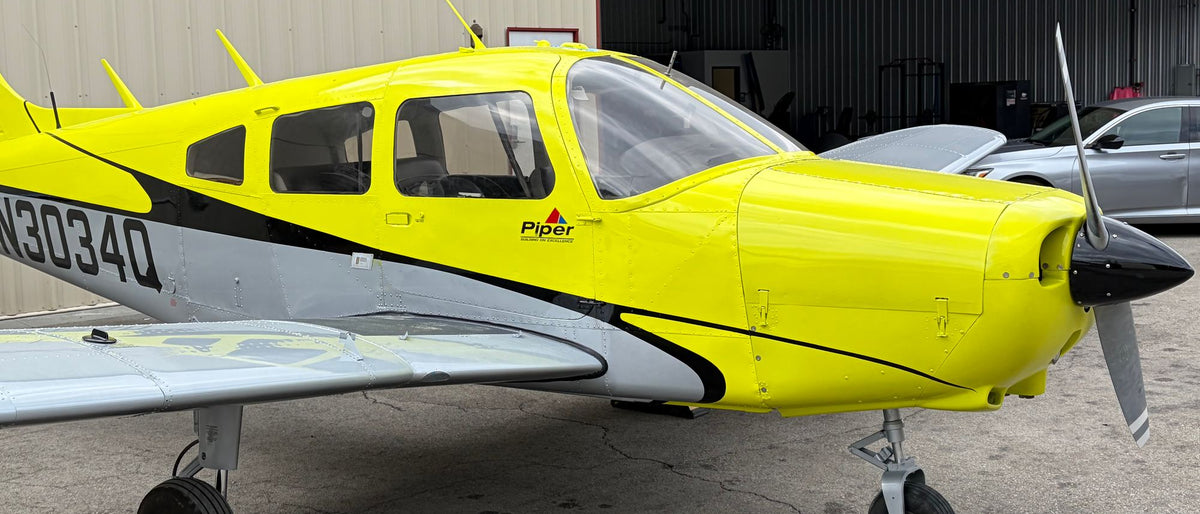
Piper Warrior N3034Q, front quarter, beside an open hangar at Van Nuys Airport
PIPER WARRIOR · 160 HP · LOW WING
The Classic 60–120 Min

Discovery Flight For One

Credited in full toward your training if you enroll within 24 hours.

One seat, one instructor, no audience. You take the controls once we are clear of the Van Nuys pattern, and your instructor signs the time into your logbook if you bring one.

  • Hands-on stick time
  • Pre-flight briefing and walk-around
  • Hollywood Sign and downtown
  • One-on-one with an FAA-certified instructor
  • Bring your logbook, we sign it

Flight Length

$229all-in · one flyer · 60 minutes
Book For One

Weight limit 180 lb for the person flying.

Or gift it →
Cessna 162 Skycatcher trainer seen nose first on the Van Nuys ramp at sunset
CESSNA 162 · OR PIPER WARRIOR
Day One 2 Hours

Two-Hour Beginner Flying Lesson

Credited in full toward your training if you enroll within 24 hours.

Half an hour on the ground learning what the yoke, the pedals and the throttle do, then about seventy minutes in the air over Simi Valley with your instructor beside you.

  • 30-minute ground lesson first
  • About 70 minutes at the controls
  • Simi Valley and the Santa Susana Mountains
  • Cessna 162 or Piper Warrior
  • Debrief and a signed logbook entry

Lesson Length

$349all-in · one student · 2 hours

Book The Lesson

Weight limit 180 lb for the person flying.

Or gift it →
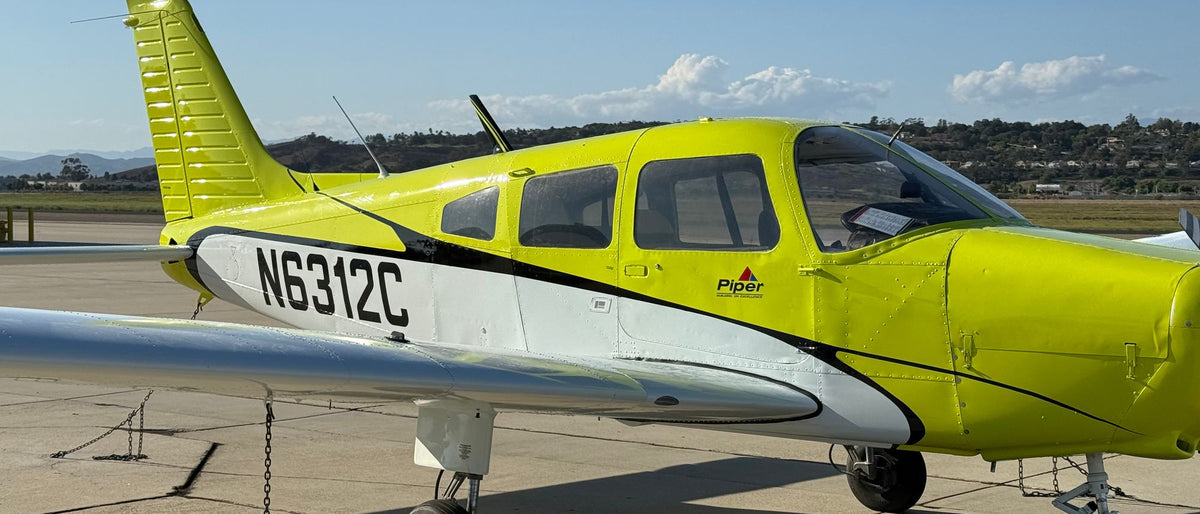
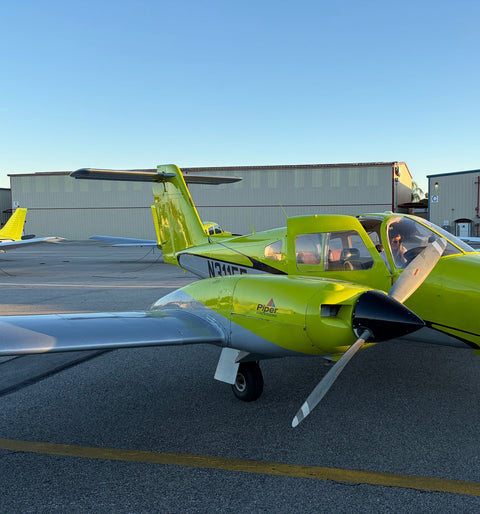
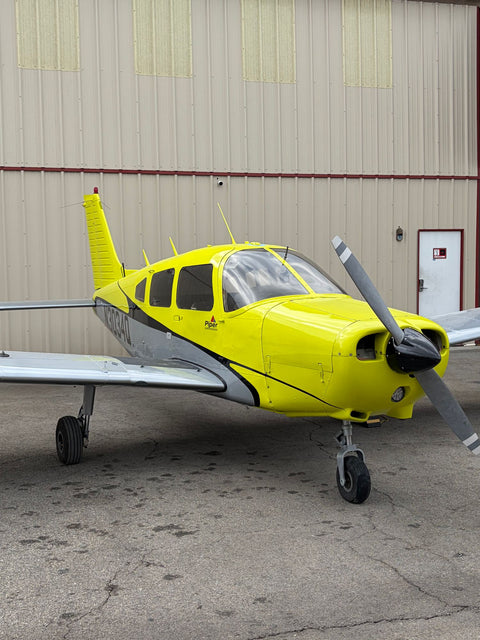
Side view of Piper Warrior N6312C on a sunny ramp, cabin and cowling in view
PIPER WARRIOR PA-28-161 · GUEST SEAT
Bring Someone 2 Hours

Two-Hour Beginner Flying Lesson For Two

One of you takes the lesson. The other rides along on the intercom.

The same two hours in the four-seat Piper Warrior, with somebody you know in the back. They sit in on the ground lesson, listen in the air and take the photographs.

  • Four-seat Piper Warrior
  • A guest in the back seat
  • Headsets for both of you
  • 30-minute ground lesson first
  • About 70 minutes at the controls

Lesson Length

$449all-in · student and guest · 2 hours

Book For Two

Weight limits 180 lb each and 360 lb combined.

Or gift it →
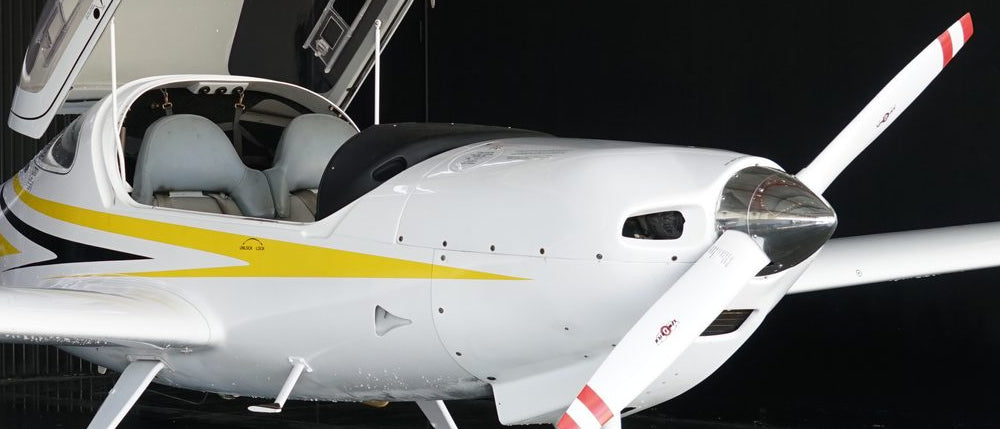
Diamond DA20 with its bubble canopy raised, showing the side-by-side cockpit
DIAMOND DA20-C1 · 125 HP · STICK
The Stick 2 Hours

Two-Hour Beginner Flying Lesson In The Diamond DA20

A stick instead of a yoke, and a canopy you can see straight out of.

Lighter on the controls than the Cessna, and quicker to show you when your feet are lazy on the rudder. A good first lesson if you already think you want the certificate.

  • Diamond DA20-C1, two seats
  • Stick and bubble canopy
  • 125 hp Continental IO-240
  • 30-minute ground lesson first
  • About 70 minutes at the controls

Lesson Length

$549all-in · one student · 2 hours

Book The DA20

Weight limit 200 lb for the person flying.

Or gift it →
0.2 VsoCertification DemonstrationA 90° crosswind the airplane must handle with no exceptional pilot skill
13 ktPHAK Worked ExampleRunway 17, wind 140 at 25: a 30° angle gives 13 kt across and 22 kt down the runway
400 ftForward Slip TouchdownWithin 400 feet beyond or on the point, ACS task IV-M
1962Placard RuleAirplanes certificated after May 3, 1962 show the demonstrated crosswind on a placard

Maximum Demonstrated Crosswind And Your Own Limit

Before an airplane type is certificated, it has to show it is "satisfactorily controllable with no exceptional degree of skill or alertness on the part of the pilot" in a 90-degree crosswind of up to 0.2 Vso. That is two-tenths of its power-off stalling speed in landing configuration, and it is how the AFH summarizes the requirement. The PHAK adds that the maximum demonstrated crosswind component is published in the AFM/POH.

Notice the word demonstrated. The handbook describes the figure as the result of a test and a placard value, and it does not call it a limitation. It does not say the airplane cannot handle more, and it does not say you can. What it does say is that pilots must determine the maximum crosswind component of each airplane they fly and avoid wind conditions beyond what the airplane can do.

Your own limit is a separate number, and early in training it should sit well below the airplane's. The pre-solo study list on our student pilot downloads page has blanks for the airplane's maximum demonstrated crosswind and for the wind limits your instructor writes in your logbook for solo flights. Fill both in at home, not at the hold-short line.

Included Every Time

What A $229 Discovery Flight Includes

$229 · All-In 60 Min Flight Time

Every discovery flight leaves from our ramp at Van Nuys Airport (KVNY) with an FAA-certificated flight instructor, and it is credited in full toward training if you enroll within 24 hours. Free rescheduling up to 24 hours before, and if the weather says no, you do not pay.

Practicing Crosswinds From Van Nuys

Van Nuys has two parallel runways, 16R/34L at 8,001 feet and 16L/34R at 4,000 feet, and they point the same way. On a day when the wind blows straight across them, there is no other runway on the field to turn to. The handbook's answer, a different runway, becomes a different airport or a different day.

A different day costs nothing. Lessons and discovery flights reschedule free up to 24 hours before, and if the weather says no, you do not pay; our weather and cancellation policy has the details. Check Van Nuys Airport weather today the evening before, and read how often you can actually fly at Van Nuys before you build a schedule around it.

Crosswind practice happens in whichever trainer you fly: the high-wing Cessna 162, the four-seat Piper Warrior, which also flies a two-hour lesson for two at $449, or the stick-flown Diamond DA20-C1, $549 for a two-hour lesson. On a day too windy for any of them, the two-hour simulator lesson in the full-motion Redbird MCX is $249.

The private pilot course is where all of this becomes routine. The FAA minimum is 40 hours under 14 CFR 61.109(a); our students who passed between 2023 and 2026 typically logged 50–60 hours, simulator included, according to our student cost study. The other Area IV landings are on our page about short-field and soft-field takeoffs and landings.

Van Nuys Airport · Los Angeles

Unbeatable Location

Van Nuys (KVNY): Class D beneath the Burbank Class C, just north of the Los Angeles Class B, 300+ flyable days, the coast thirteen miles away.

KVNY · Van Nuys · Los AngelesSchematic · Not For Navigation
Schematic chart of Van Nuys Airport (KVNY) and the airspace around it: the Van Nuys Class D, the Burbank Class C, the LAX Class B shelves and the Simi Valley practice area. Not for navigation. 405101118 Simi Valley Santa Clarita San Fernando Glendale Pasadena Calabasas Santa Monica Thousand Oaks Hollywood San Fernando Valley Santa Monica Mountains Pacific Ocean Van Nuys Class D Burbank Class C LAX Class B KVNY · Van Nuys KBUR · Burbank KWHP · Whiteman LAX Practice Area 2 3 4 5 6 7 8 9 10 11 PA
  • Class B
  • Class C
  • Class D
  • Practice Area
  • Typical Route

KVNY · Class D Tower

Van Nuys Airport (KVNY)

Runways
16R/34L · 8,001 Ft
16L/34R · 4,000 Ft
Nearby
Burbank (KBUR) Class C · 11 Mi E
Whiteman (KWHP) · 6 Mi NE
Find Us
7900 Balboa Blvd, Main Terminal Unit 108, Van Nuys, CA 91406
Open 7 days · 9:00 AM – 9:00 PM
Pick A Rating

Every Hour And Every Dollar, Course By Course

Each course is a package price, with the airplane, simulator, instruction and ground hours listed. The Private Pilot course is where these landings are taught.

Questions About Crosswind Landings And Slips

Is Maximum Demonstrated Crosswind A Limit?

Not in the sense of a red line. The AFH treats it as a value shown during certification and tells you to know each airplane's figure and stay within what the airplane can do. In airplanes certificated after May 3, 1962, the demonstrated crosswind velocity is shown on a placard.

How Do I Estimate The Crosswind In My Head?

Use fractions of the wind: half at 30 degrees, about seven-tenths at 45, about nine-tenths at 60, and all of it at 90. A 16-knot wind 45 degrees off the runway is about 11 knots of crosswind. Some pilots use a clock face instead, where 15 degrees is a quarter of the wind and 30 is half; it reads a little high at 45 degrees, which errs on the safe side.

Can You Slip With Flaps Extended?

It depends on the airplane. The AFH says there may be recommendations or limitations on slips with flaps extended, for aerodynamic reasons, and sends you to the AFM/POH. Some POHs prohibit it or caution against it, so check the one for the exact airplane before you try it.

What Is The Forward Slip Standard On The Checkride?

ACS task IV-M wants the touchdown within 400 feet beyond or on the specified point and a ground track aligned with the runway center or landing path. The 400 feet matches the normal landing in task IV-B; the short-field landing tightens it to 200.

Which Runways Does Van Nuys Have?

Two parallel runways, 16R/34L and 16L/34R. The airport is a Class D field under the Los Angeles Class B shelf and one of the world's busiest general-aviation airports.

What Happens To My Lesson If The Wind Is Too Strong?

If the weather says no, you do not pay, and you can reschedule a lesson or discovery flight free up to 24 hours before. If you would still like to train that day, the Redbird MCX is an FAA-approved advanced aviation training device and is never canceled for weather.

Bring The Wind, We Will Bring The Instructor

Take a two-hour lesson for $349, fly a 60-minute discovery flight for $229, or talk through a training plan at a free half-hour consultation. We are at 7900 Balboa Blvd, Van Nuys Airport, open 9 AM to 9 PM, seven days a week.

Free rescheduling up to 24 hours before, and if the weather says no, you do not pay.