




















If you are not a United States citizen and you want flight training in the US, there is a security clearance you must have before your first training flight. It is run by the Transportation Security Administration under 49 CFR part 1552 — the program many people still know as the Alien Flight Student Program, now administered as the Flight Training Security Program — and it applies to far more people than most prospective students expect, including green card holders, people already living and working in the US, and people who hold a foreign pilot license.
Everything on this page describing TSA procedure is taken from the current text of 49 CFR part 1552, read in September 2026, with the section cited at each point. Fees, portal addresses and processing practice change more often than the regulation does. Confirm the current fee and the current portal with TSA, and confirm your immigration position with a qualified immigration attorney, before you book travel or pay anybody.
For the training itself — the certificates, the timelines and the costs — start with our guide to learning to fly in Los Angeles; this page covers the paperwork that international students need first.
This guide explains who needs AFSP clearance and who is exempt, exactly how the application works step by step, what it costs, how long it takes, how fingerprinting works, how long clearance lasts, and how the M-1 student visa question fits alongside it.
How We Fit In: You Fly LA sells discovery flights — the introductory flight where you take the controls with an instructor beside you. We also run the certificate courses themselves. The FAA issues your certificate, not the school. We are not an SEVP-certified school, so we cannot issue an I-20 for a student visa. For certificate training we handle the TSA paperwork with you, here at Van Nuys. The good news for visitors: a discovery flight is generally exempt from AFSP, so you can fly with us straight away.
Who Needs A TSA Clearance
The rule is 49 CFR part 1552. Under 49 CFR 1552.3 a "candidate" is any person who is not a US citizen or national and who applies for flight training or recurrent training from a flight training provider, and under 49 CFR 1552.31(a) "each candidate must complete a security threat assessment and receive a Determination of Eligibility from TSA prior to initiating flight training." A flight training provider is prohibited by 49 CFR 1552.7(a) from giving flight training or access to flight training equipment to anyone until it has established that they are a US citizen, a US national, a Department of Defense endorsee, or a candidate holding a valid Determination of Eligibility. There is no way for a school to start you on goodwill; the prohibition falls on us, not on you.
That includes categories people often assume are excluded:
- Lawful permanent residents — green card holders are not US citizens and do need AFSP clearance
- Holders of work visas such as H-1B, L-1 or O-1 who live in the United States
- Tourists on a B-2 visa or the Visa Waiver Program
- Students on F-1 visas studying something unrelated
- Holders of foreign pilot licenses seeking a US certificate or rating
- People taking training outside the United States toward a US airman certificate
One important change from how this program used to work, and the reason older guides online will mislead you: a Determination of Eligibility is no longer tied to a single course. Under 49 CFR 1552.31(d) it "expires 5 years after the date it was issued", subject to the exceptions in the next section, so one assessment can cover a sequence of training rather than one certificate at a time. What is still per-course is the training event: under 49 CFR 1552.51(a) the school must notify TSA through the FTSP Portal of every proposed and actual flight training event you schedule, "without regard to whether that training is intended to result in certification."
Who Is Exempt From AFSP
You do not need an AFSP security threat assessment if any of the following apply.
| Exemption | Detail | Where It Comes From |
|---|---|---|
| Discovery and demonstration flights | The definition of "flight training" expressly excludes demonstration flights for marketing purposes, and the definition of that term expressly includes "an orientation, familiarization, discovery flight for the purpose of demonstrating a flight training provider's training program to a potential candidate" — which is why you can book a discovery flight with us as a visitor | 49 CFR 1552.3 |
| Ground training only | "Flight training" excludes ground training, so classroom and theory instruction with no flying is outside the rule | 49 CFR 1552.3 |
| Balloons, gliders, ultralights and unmanned aircraft | Instruction in these is excluded from the definition of flight training | 49 CFR 1552.3 |
| Military training | Training provided by the Department of Defense, the US Coast Guard, or an entity training under contract to either | 49 CFR 1552.3 |
| DoD endorsement | A DoD endorsee is exempt from the security threat assessment where the DoD attaché with jurisdiction has notified TSA through the FTSP Portal | 49 CFR 1552.7(a)(2) |
| US citizens and nationals | Not candidates under the rule at all, but a school must examine government-issued proof of citizenship or nationality before providing any flight training | 49 CFR 1552.7(a)(1) |
Recurrent training is no longer outside the rule. Older guidance — and a great deal of what is still published online — says that flight reviews and proficiency checks are exempt. Under the current text, a candidate is defined as an alien who applies for flight training "or recurrent training", and 49 CFR 1552.5(a) applies the part to "any individual applying for flight training or recurrent flight training". If you hold a foreign or FAA certificate and you are coming here for periodic training rather than a new rating, do not assume you are exempt: ask TSA or ask us, and allow the same lead time as anyone else.
US citizens are not exempt from everything: a flight school must verify citizenship before providing flight training, normally with a valid US passport or a birth certificate together with government photo identification.
The TSA Process, Step By Step
The sequence below follows the obligations the regulation actually places on you and on us. The two clocks that matter most to your travel planning are in steps six and seven, and they are the numbers to plan around: TSA will process a complete application within 30 days (49 CFR 1552.31(e)), and a school may begin training more than 30 days after TSA acknowledges the training-event notification, or more than 5 business days after it if you qualify for expedited processing (49 CFR 1552.51(e) and (f)).
Step One: Tell The Flight School Before You Apply
Contact the school first. Under 49 CFR 1552.51(a) and (b) the school — not you — notifies TSA of each proposed flight training event, and that notification must carry your name, the rating you could receive, the estimated start and end dates and the training location. None of that can be filed before you and the school have agreed what you are training for and when. Applying in isolation is the most common way to stall a start date. If you are still choosing a provider, our page on California flight schools compared sets out what to check first.
Step Two: Create Your TSA Portal Account
Under 49 CFR 1552.17(a), "candidates must obtain an FTSP Portal account and use the FTSP Portal to submit the information and fees necessary to initiate a security threat assessment." Set the account up early; account creation and password delivery have historically taken a day or two and it is a poor use of your lead time. Keep the credentials safe — the same account is what carries your record forward across later training, which is the mechanism that saves you repeating biometrics. Confirm the current portal address with TSA rather than with a search result, because the program's public-facing address has changed.
Step Three: Submit Your Security Threat Assessment Application
49 CFR 1552.31(b) requires three things: the biographic and biometric information TSA determines is necessary, identity verification documents, and the applicable fee. In practice that means biographical details, passport and visa information, immigration status and an address history, with legible scans of your passport and visa pages uploaded. Under 49 CFR 1552.19, a false statement, misrepresentation or material omission at this stage can carry criminal penalties as well as a denial — so where a question is ambiguous, answer it accurately and add an explanation rather than guessing at the tidier answer.
Step Four: The School Files The Training Event And TSA Acknowledges It
The school notifies TSA through the portal of the proposed training event under 49 CFR 1552.51(a), and TSA acknowledges receipt under 1552.51(c). That acknowledgement is the event that starts the waiting-period clock in step seven, so it is worth confirming with the school that it has actually been filed rather than assuming somebody is watching for it.
Step Five: Pay The Fee
A fee is payable with the application under 49 CFR 1552.31(b)(3). We do not publish the amount, because the regulation does not set one. Under 49 CFR 1552.39(a) the fee is "as determined by TSA, which will be published through notice in the Federal Register and posted on the FTSP Portal", and changes are published the same way. Any figure you read on a flight school's website — including a figure that was correct when it was written — may not be the figure you pay. Get it from TSA, and budget for it as a real cost. Under 49 CFR 1552.39(b), "TSA will not issue fee refunds unless the fee is paid in error."
Step Six: Biometrics And The Assessment Itself
The assessment described in 49 CFR 1552.31(c) has four components: confirmation of your identity, a check of relevant databases, an immigration check, and "an FBI fingerprint-based criminal history records check to determine whether the individual has a disqualifying criminal offense in accordance with the requirements of § 1544.229". Follow the biometric collection instructions TSA gives you rather than anticipating them — submitting prints outside the process TSA specifies has historically meant repeating the step. Collection sites exist across the Los Angeles area.
49 CFR 1552.31(e) states plainly that "TSA will process complete security threat assessment applications within 30 days." The operative word is complete. A missing address year or an unreadable passport scan restarts that clock in practice, which is why step three deserves an unhurried afternoon.
If TSA issues a Determination of Ineligibility on a record you believe is wrong, 49 CFR 1552.31(f) gives you 180 days from the initial determination to correct the record by submitting the missing or corrected documents plus anything further TSA requests.
Step Seven: The Waiting Period Before Training Can Start
This is the step that decides your start date, and it is separate from your own approval. Under 49 CFR 1552.51(e) the school "may initiate flight training if more than 30 days have elapsed since TSA acknowledged receipt" of the training-event notification.
There is a faster route. Under 49 CFR 1552.51(f) training may begin after more than 5 business days where TSA confirms in its acknowledgement that you are eligible for expedited processing. The rule lists who qualifies: a candidate who holds an FAA airman certificate with a type rating; who holds a type-rated certificate from a foreign country recognized by a US agency, including a military agency; who is employed by a domestic or foreign air carrier with an approved security program under parts 1544 or 1546; who has unescorted access to a secured area of an airport under part 1542; or who is a lawful permanent resident. That last category matters to a great many people who assume a green card gives them no advantage here. It does not exempt you from the assessment — but it can cut the waiting period from 30 days to 5 business days.
Step Eight: Arrive, Be Photographed, And Fly
Under 49 CFR 1552.51(d), when you arrive for training the school must photograph you and upload the photograph to the portal within 5 business days. It must be a photograph taken at the school, not a copy of the one in your passport. The school also updates the actual start and end dates and the actual training locations under 1552.51(g), and must report training that was not completed, with a brief reason. None of this is onerous; it is simply why a school will ask for a few minutes of admin on a day you expected to spend flying.
How Long Your Determination Of Eligibility Lasts
This is the part of the program that has changed most, and where out-of-date guidance does the most damage to a training plan. There is no longer a 180-day window to start and a 365-day window to finish. Under 49 CFR 1552.31(d)(1) the Determination of Eligibility "expires 5 years after the date it was issued" — with three exceptions, one of which will apply to most international students.
| Trigger | What Happens | What To Do About It |
|---|---|---|
| Five years from issue | The determination expires on that date | Nothing, unless your training will run past it |
| Your authorization to remain in the US expires sooner | The determination expires on the date your authorized stay does | This is the one that catches people. Extend it by submitting updated documentation of your authorization to remain, up to a total of five years. |
| A disqualifying criminal offense under 49 CFR 1544.229(d) | Expires on the date of conviction or of a finding of not guilty by reason of insanity | Nothing available here |
| TSA determines you pose a security threat | The determination ends | See the record-correction route in 49 CFR 1552.31(f) |
Two consequences worth planning around. 49 CFR 1552.31(d)(2) states that "no candidate may engage in flight training after the expiration of the candidate's Determination of Eligibility" — so if your eligibility lapses mid-course, training stops that day, whatever the school has booked. And because the second row above ties your eligibility to your authorized stay, a visa or status that is shorter than your training plan is the real constraint, not the five years. Work out the end date of your authorized stay first, then build the training schedule inside it.
Visiting Los Angeles? Fly With Us Now
Discovery flights are exempt from the TSA clearance requirement. Take the controls over Los Angeles this week — $229 for one person, $299 for two.
Book A Discovery Flight →M-1 Versus F-1: The Distinction That Decides Everything
TSA eligibility and immigration status are two entirely separate matters, and confusing them causes real problems. A TSA Determination of Eligibility is not a visa and gives you no right to be in the United States. Your immigration status determines whether you may lawfully undertake the training at all.
Where flight training is your principal purpose in the United States, the category is normally M-1, not F-1. The US Department of State sorts the two by the kind of institution: a "university or college" is the F category, while a "vocational or other recognized nonacademic institution, other than a language training program" is the M category. Either way the school must be certified by the Student and Exchange Visitor Program, must issue you a Form I-20, and you must be registered in SEVIS and pay the SEVIS I-901 fee before applying at a US embassy or consulate.
People assume these are two flavors of the same thing. They are not. The table below sets out the differences that actually affect a flight student, taken from 8 CFR 214.2(f) for F-1 and 8 CFR 214.2(m) for M-1, read in September 2026.
| Point | F-1 — Academic Student | M-1 — Vocational Student |
|---|---|---|
| Type of institution | University or college | Vocational or other recognized nonacademic institution, other than a language training program |
| How long you are admitted for | Duration of status — the time spent pursuing a full course of study, or authorized practical training after it (8 CFR 214.2(f)(5)(i)) | A fixed period: the course of study, plus practical training after it, plus 30 days to depart — "but not to exceed a total period of one year" (8 CFR 214.2(m)(5)) |
| Earliest entry | Up to 30 days before the report or program start date on the Form I-20 | Up to 30 days before the report or start date on the Form I-20 |
| Working during the course | On-campus employment permitted, not exceeding 20 hours a week while school is in session (8 CFR 214.2(f)(9)(i)) | "Except as provided in paragraph (m)(14) of this section, a student may not accept employment" (8 CFR 214.2(m)(13)) |
| Practical training | Available after one full academic year; 12 months may be authorized, with a further 12 on moving to a higher educational level (8 CFR 214.2(f)(10)) | Only after the course of study is completed. One month is granted for each four months of full-time study, and not more than six months in total (8 CFR 214.2(m)(14)) |
| Changing what you study | Moving between educational levels is permitted through transfer procedures | "An M-1 student may not change educational objective" (8 CFR 214.2(m)(12)) |
| Transferring schools | Permitted under the transfer procedure in 8 CFR 214.2(f)(8) | Not after six months from first admission as an M-1, unless you cannot remain at the original school for reasons beyond your control (8 CFR 214.2(m)(11)(i)) |
| What counts as full time | Set by the academic program | For a vocational curriculum, at least 18 clock hours of attendance a week where classroom instruction dominates, or at least 22 where shop or laboratory work dominates (8 CFR 214.2(m)(9)(iii)) |
Read the bottom four rows together and the shape of the M-1 becomes clear: it is a category designed for a short, defined, full-time vocational course that you complete at the school that admitted you. It is unforgiving of changes of plan. If your intention is a private certificate followed later by an instrument rating and a commercial certificate, do not assume a single M-1 admission carries you through all three — the one-year limit in 8 CFR 214.2(m)(5), the bar on changing educational objective in (m)(12) and the transfer restriction in (m)(11) each bear on that plan, and the answer depends on facts specific to you.
We are not an SEVP-certified school and cannot issue an I-20. That is stated plainly rather than buried, because it is the single fastest way to narrow your search: if you need an M-1, you need a school that can issue the form, and no amount of enthusiasm on either side substitutes for it. Our guides to aviation schools in Los Angeles and flight academies in California set out what else to ask.
Timing is worth knowing in advance. The Department of State states that student visas for new students can be issued up to 365 days before the start date of a course of study, but that you will not be allowed to enter the United States on a student visa more than 30 days before that start date. Plan the consular appointment early and the flight late.
Other statuses come up frequently. A B-1 or B-2 visitor may in some circumstances take recreational flight training that is incidental to a visit, but flight training as the primary purpose of the trip is not permitted on a visitor visa, and this is an area where people get it wrong. F-1 students studying something else may sometimes train recreationally, subject to their designated school official's guidance. Holders of work visas and green card holders are already lawfully present and generally have no immigration obstacle — only the AFSP requirement. Immigration status is a legal question specific to your circumstances; get advice on it rather than relying on any flight school's summary, including this one.
Weight Limits: The Constraint Nobody Publishes
This is the section we would want to read if we were booking training from another continent, and it is the one almost no school puts on its website. A training airplane has a maximum takeoff weight, and once you subtract the empty aircraft, full fuel and a flight bag, what is left for the two people in the front seats is a real and finite number. Finding that out on arrival, having bought a flight and a visa, is a genuinely expensive way to learn it.
So here are our operating limits, plainly.
| Aircraft | Maximum Per Person | Maximum Combined, Both Front Seats | Approximate Metric Equivalent |
|---|---|---|---|
| Piper Warrior PA-28-161 | 180 lb | 360 lb | About 82 kg per person, about 163 kg combined |
| Cirrus SR22 | 200 lb | 400 lb | About 91 kg per person, about 181 kg combined |
Three things follow from that table, and they are worth acting on before you buy a ticket.
- The combined figure is the binding one. You are flying with an instructor, and the instructor has a weight too. Two people at the per-person limit reach the combined limit exactly, which means there is no slack in the number.
- Tell us your weight when you inquire, not when you arrive. Nobody enjoys the question and everybody prefers it to the alternative. If the number is close, we can tell you honestly which aircraft works and whether the plan is viable, and we would far rather do that by email three months out.
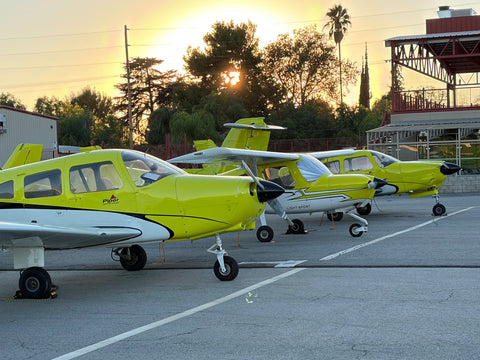
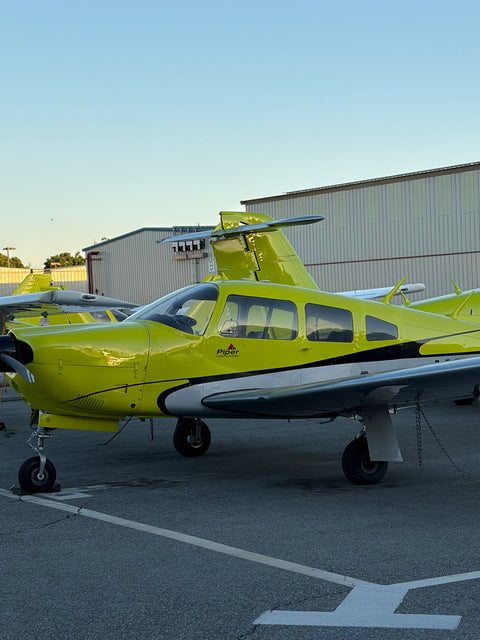
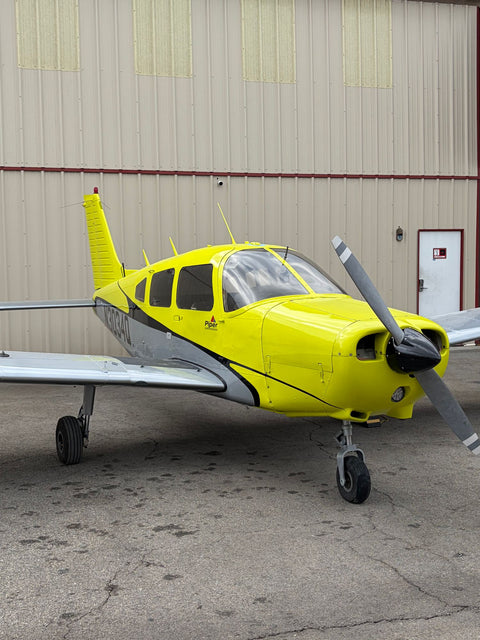
- The aircraft differ, so the answer is not simply yes or no. The Cirrus carries more than the Warrior, and it also costs more per hour. Where weight is the constraint, that trade is the conversation to have. Our fleet is set out on the airplanes you'll fly, with detail on the Piper Warrior PA-28-161 and the Cirrus SR22.
The same limits apply to discovery flights, which is the other reason to raise it early: a visitor who books a discovery flight and cannot fly it has lost a day of a holiday as well as the booking.
Documents To Prepare
- Passport, valid well beyond your intended training period
- Visa and I-94 record, or green card if you are a permanent resident
- Address history covering the last five years
- Any foreign pilot license and logbook you already hold
- An FAA medical certificate from an aviation medical examiner in the United States
- Evidence of English language proficiency, which the FAA requires for any certificate
Documents Checklist
Here is the same list arranged in the order you will actually be asked for each item, with who asks for it and when. Print it and tick it off; almost every delay in an international student's start date traces back to one line on this list.
| Document | Who Needs It | When |
|---|---|---|
| Passport (biographical page scan, plus the original on day one) | TSA security threat assessment; the flight school | Before you submit the application |
| Visa page and I-94 record, or green card front and back | TSA security threat assessment; the flight school | Before you submit the application |
| Five-year address history with dates | TSA security threat assessment | When completing the application form |
| The school's details for the training event notification | The school, to file the notification under 49 CFR 1552.51 | Agree the course and dates before anyone files anything |
| Payment method for the TSA fee | TSA, at the amount published on its portal | With the application, under 49 CFR 1552.31(b)(3) |
| Biometric collection instructions from TSA | The collection site TSA directs you to | When TSA instructs, and not before |
| Your weight, honestly stated | The flight school, for weight and balance | At inquiry, before you book travel |
| I-20 from an SEVP-certified school and SEVIS fee receipt | US consulate, if you need an M-1 visa | Before your consular interview and travel |
| FAA medical certificate (third class minimum for private pilot) | The flight school; required before solo under 14 CFR 61.103 | Book the AME appointment for your first week in Los Angeles |
| Foreign pilot license, medical and logbook, if you hold them | The flight school; the FAA for a 14 CFR 61.75 certificate | Bring originals on day one |
| TSA Determination of Eligibility and your in-person photograph | The flight school, which uploads the photo within 5 business days | First training day |
One practical note on timing: the FAA medical and the TSA application can run in parallel, because neither depends on the other. Starting both in the same week is the single easiest way to shorten the wait before your first lesson. Where to find an aviation medical examiner here, and what the exam covers, is in our guide to the FAA medical certificate process in Los Angeles.
A third piece of paperwork runs alongside both, and it is the one international students most often forget until it holds up a solo: the FAA student pilot certificate itself, applied for through the FAA's IACRA system with your instructor. Our walkthrough of the IACRA student pilot certificate application covers the FTN, the 8710-1 form, which category and class to select, and the errors that send an application back to the start. A plainer explanation of what that certificate is and when you need it is on our student pilot certificate guide.
Training In Los Angeles As An International Student
Van Nuys Airport (KVNY) is one of the busiest general aviation airports in the world, and Southern California offers flyable weather most of the year, which matters a great deal when you are working against an authorized stay that is shorter than five years. The airspace is complex and the radio work is fast, which produces pilots who are comfortable operating anywhere. Read more on our Van Nuys Airport and flight training at Van Nuys pages, and see the individual certificate guides for private pilot, instrument rating, commercial pilot and multi-engine, or the full airline pilot career program.
For the training sequence itself rather than the paperwork, our step-by-step guide to how to become a pilot in California sets out the six stages from discovery flight to checkride, with the real California costs and elapsed times at each one. It is the plain-English version of what your training year will look like once the TSA clearance is in hand.
Frequently Asked Questions
Who Needs A TSA Security Threat Assessment For Flight Training?
Anyone who is not a US citizen or national and who applies for flight training or recurrent training from a flight training provider. Under 49 CFR 1552.31(a) each such candidate must complete a security threat assessment and receive a Determination of Eligibility from TSA before flight training begins. That includes green card holders, work visa holders, tourists and holders of foreign pilot licenses.
Do Green Card Holders Need TSA Approval For Flight Training?
Yes. Lawful permanent residents are not US citizens and are covered by the rule, which surprises people every year. There is one consolation: 49 CFR 1552.51(f) lists lawful permanent residents among the candidates eligible for expedited processing, which can reduce the waiting period before training may begin from more than 30 days to more than 5 business days.
Do I Need TSA Clearance For A Discovery Flight?
No. Discovery and demonstration flights conducted for marketing purposes are exempt. You can book a You Fly LA discovery flight without an AFSP application.
How Much Does The TSA Application Cost?
We do not publish a figure, because the regulation does not set one. Under 49 CFR 1552.39(a) the fee is determined by TSA and published through notice in the Federal Register and posted on the TSA portal, and it changes the same way. Get the current amount from TSA before you budget, and note that under 49 CFR 1552.39(b) fees are not refunded unless paid in error.
How Long Does TSA Approval Take?
49 CFR 1552.31(e) states that TSA will process complete security threat assessment applications within 30 days. Separately, 49 CFR 1552.51(e) allows a school to begin training more than 30 days after TSA acknowledges the training event notification, or more than 5 business days after it where the candidate qualifies for expedited processing under 1552.51(f). Plan around those two clocks rather than around a figure from an older guide.
When Should I Submit My Biometrics?
Only when TSA instructs you to, and at the collection site it directs you to. Biometric information is part of the application under 49 CFR 1552.31(b), and the assessment includes an FBI fingerprint-based criminal history records check under 1552.31(c)(4). Anticipating the step rather than following the instruction has historically meant repeating it.
How Long Is My TSA Approval Valid?
Under 49 CFR 1552.31(d)(1) a Determination of Eligibility expires five years after the date it was issued — but it expires earlier if your authorization to remain in the United States expires first, in which case it ends on that date. You can extend it up to a total of five years by submitting updated documentation of your authorization to remain. No candidate may train after it expires.
Do I Need A Separate Application For Each Certificate Or Rating?
Not for the security threat assessment itself, which under 49 CFR 1552.31(d) lasts five years subject to your authorized stay. What is per-course is the training event: under 49 CFR 1552.51(a) the school must notify TSA of every proposed and actual flight training event, whether or not it leads to a certificate, and the waiting period in 1552.51(e) applies to each notification.
Do I Need An M-1 Visa To Train In The United States?
If flight training is your principal purpose in the US, generally yes, and it requires an I-20 from an SEVP-certified school. The Department of State assigns vocational or other recognized nonacademic institutions to the M category and universities and colleges to the F category. An M-1 is admitted for the course of study plus practical training plus 30 days to depart, not to exceed one year in total under 8 CFR 214.2(m)(5), may not accept employment under 8 CFR 214.2(m)(13), and may not change educational objective under 8 CFR 214.2(m)(12). If you are already lawfully in the US on another status, your situation depends on that status. Take proper immigration advice.
Can I Convert My Foreign Pilot License To An FAA License?
If you hold a license issued by an ICAO contracting state, you may be able to obtain a restricted FAA private pilot certificate issued on the basis of it under 14 CFR 61.75, which requires FAA verification with the issuing authority. A standalone FAA certificate requires the full training and testing, and AFSP clearance if you are not a US citizen.
Do I Need An FAA Medical Certificate?
Yes, at least a third class for a private pilot certificate, issued by an aviation medical examiner. Foreign medical certificates are not accepted for FAA certificates, and there are AMEs across Los Angeles.
What Level Of English Do I Need?
The FAA requires that you read, speak, write and understand English, and it is assessed during your training and at the checkride. Radio work in the Los Angeles basin is fast, so genuine conversational fluency makes training much easier as well as safer.
Is There A Weight Limit For Flight Training?
Yes, and it is a real constraint rather than a formality. Our limit in the Piper Warrior PA-28-161 is 180 lb per person and 360 lb combined for both front seats; in the Cirrus SR22 it is 200 lb per person and 400 lb combined. Because you fly with an instructor, the combined figure is usually the binding one. Tell us your weight when you inquire rather than when you arrive, so we can tell you honestly which aircraft works.
What Is The Difference Between An M-1 And An F-1 Visa?
The F category is for universities and colleges and the M category is for vocational or other recognized nonacademic institutions, so flight training as your principal purpose is normally M-1. An F-1 is admitted for duration of status, may work on campus up to 20 hours a week while school is in session, and may be authorized 12 months of practical training. An M-1 is admitted for a fixed period not exceeding one year in total, may not accept employment, may not change educational objective, may not transfer schools after six months except for reasons beyond their control, and may receive one month of practical training for each four months of study up to six months in all.
Ready To Enroll? You Fly LA runs the certificate courses at Van Nuys and handles the TSA applications for flight training in Los Angeles on the same ramp. You Fly LA is at Van Nuys Airport, 7900 Balboa Blvd, Main Terminal Unit 108, Van Nuys, CA 91406, open 9 AM to 9 PM seven days a week. Call (818) 330-1318. This page is general information, not legal or immigration advice.
No Paperwork Needed To Fly Today
Discovery flights are exempt from AFSP. Sixty minutes over Los Angeles with the controls in your hands.
Book A Discovery Flight →