
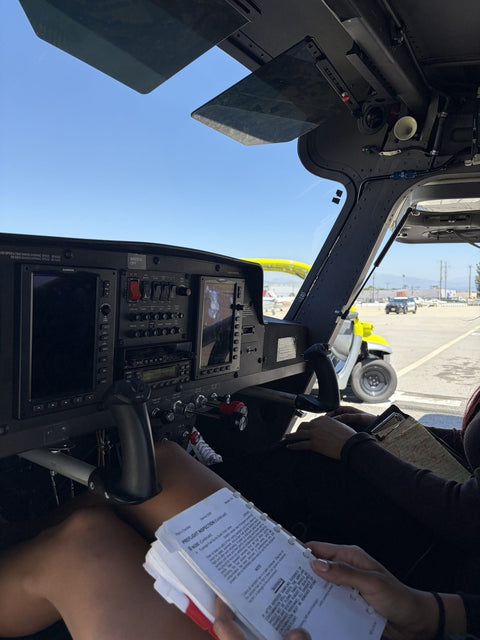
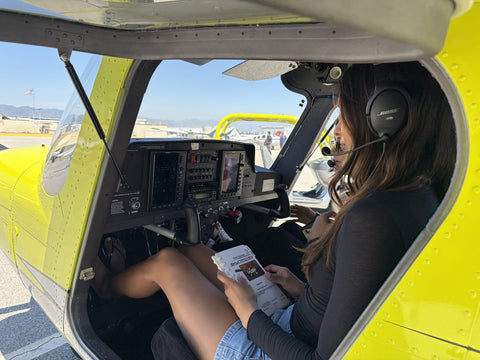








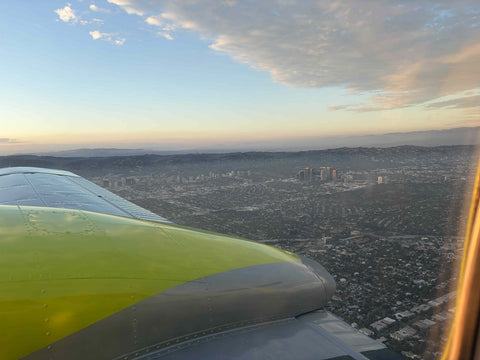




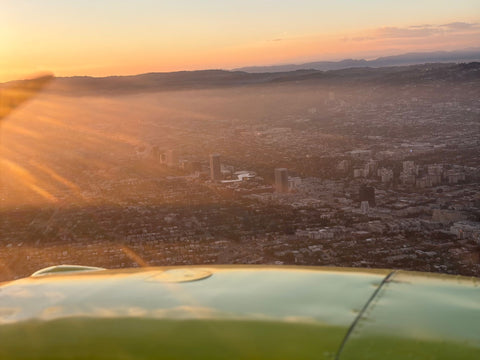
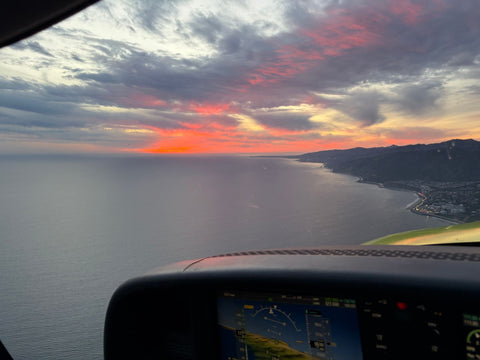


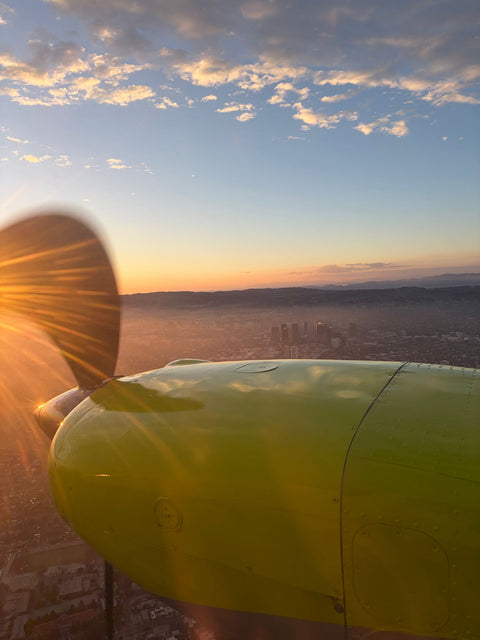




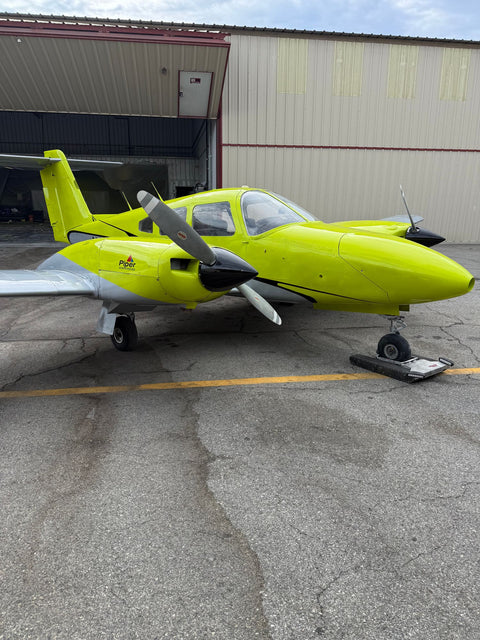
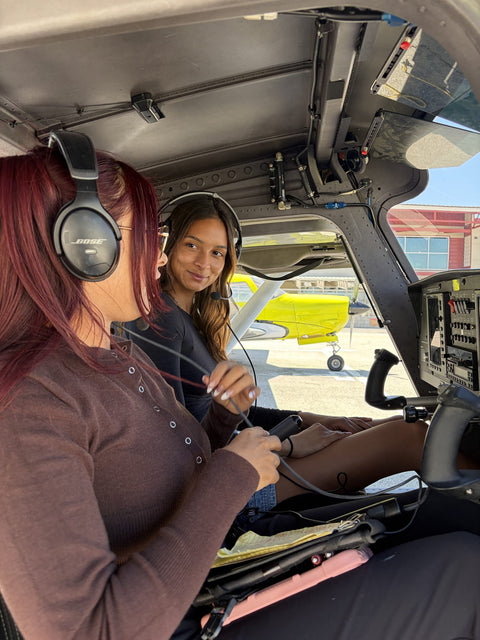



The Cessna 162 Skycatcher is the most interesting failure in modern light aircraft. Cessna built it to be the airplane that brought new pilots into aviation through the then-new light sport category, sold a few hundred of them, and killed the program inside four years. It remains a genuinely pleasant little two-seater, it still turns up in light sport rental fleets, and it is one of the most searched-for airplanes that almost nobody has flown. This page is a plain-English reference to what it is, what its numbers are, and what you will find in its Pilot's Operating Handbook.
This is a reference page, not an offer. It exists because people ask about this airplane. You Fly LA flies discovery flights and simulator sessions from Van Nuys Airport and runs certificate courses; for checkouts and currency after your training, call or text (818) 330-1318. Which airplane your flight uses is confirmed on the day, and we do not promise a specific type in advance.
Quick Answer: The Cessna 162 Skycatcher is a two-seat, 100-horsepower light sport trainer that Cessna built from 2009 to 2013. It cruises at roughly 109 to 112 knots and has a typical useful load of about 450 to 490 pounds, which is why most flights leave with partial fuel. A sport pilot can fly it on a driver's license, and at Van Nuys it is the airplane our Sport Pilot course is flown in.
Book A Discovery Flight · $229 Book A Free Consultation
What The Cessna 162 Skycatcher Is
The Skycatcher is a two-seat, single-engine, high-wing, fixed-gear light sport aircraft. It is all of the things a Cessna traditionally is — strut-braced high wing, tricycle gear, a Continental flat-four out front — shrunk down and lightened until it fits inside the weight limits of the light sport category. It seats a pilot and one passenger side by side, it has a fixed-pitch propeller, and it carries a glass panel rather than steam gauges.
Cessna announced it in 2006 as the Model 162, flew the proof-of-concept in 2008, and delivered the first production aircraft in December 2009. Production ended in December 2013. It is known by a handful of names in search — Cessna Skycatcher, Cessna 162, C162, Cessna LSA — and they are all the same airplane.
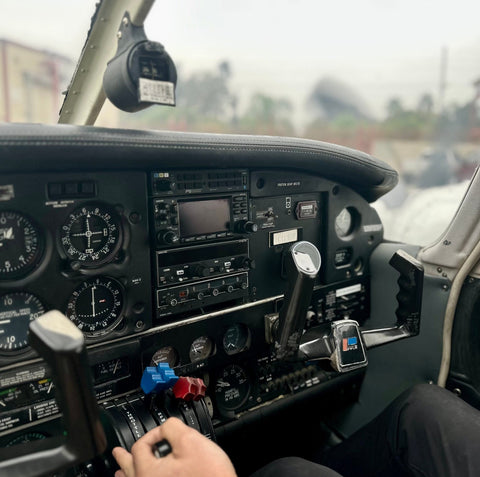
Two design details set it apart from the rest of the Cessna line. The doors swing upward rather than outward, which is unusual for a Cessna and genuinely convenient on a crowded ramp. And the control yokes are single-handed panel-mounted sticks rather than the traditional Cessna wheel on a shaft, an arrangement that frees up cabin space and looks nothing like the 172 it superficially resembles.
Model History And Production Timeline
The Skycatcher had a short and eventful life, and the dates are worth having in one place because they explain both why the airplane exists and why so few of them do.
| Date | Event |
|---|---|
| September 2004 | The FAA's light sport aircraft category and sport pilot certificate come into force, creating the market the airplane was designed for. |
| July 2006 | Cessna announces it is studying a light sport aircraft and begins surveying its customer base. |
| 2007 | The Model 162 Skycatcher is formally launched. The announced price is in the region of $110,000, deliberately positioned to undercut the established LSA field. |
| 2008 | The proof-of-concept aircraft flies. Two prototypes are subsequently lost in separate spin-testing accidents, both crews escaping by parachute, and the tail and spin-recovery behavior are revised. |
| 2008 | Cessna confirms that airframe production will be contracted to Shenyang Aircraft Corporation in China, with final assembly in Kansas. The decision is unpopular with part of the traditional Cessna customer base. |
| July 2009 | The aircraft receives its ASTM light sport approval. |
| December 2009 | First production aircraft delivered to a customer. |
| 2011 | A mandatory service bulletin requires wing structural modifications across the delivered fleet. Cessna carries out the work, but it costs the program time and confidence. |
| November 2011 | List price reaches roughly $149,000 — an increase of about a third on the launch figure, and enough to let order-holders cancel under the terms of their contracts. Many do. |
| December 2013 | Production ends. Around 275 airframes were built in total; published figures put customer deliveries near 192 against an initial order book of more than a thousand. |
| 2016 | Cessna scraps the remaining unsold airframes rather than discounting them into the market, which is why the used population never grew. |
Two consequences follow for anyone dealing with one today. The fleet is tiny and geographically scattered, so parts and type-experienced maintenance are harder to find than for a 152 or a 172. And because the population is small and the production run short, there is only one basic model — there is no Skycatcher equivalent of the Warrior, Warrior II and Warrior III sequence. Differences between individual aircraft come from serial number range, service bulletin compliance and installed equipment rather than from model variants, which is another reason to work from the handbook issued for that specific tail number.
Its Place As A Light Sport Aircraft
The Skycatcher exists because of a rule change. In 2004 the FAA created the light sport aircraft category and the sport pilot certificate alongside it, aiming to lower the cost and the medical barrier to entry into flying. Manufacturers responded with a wave of small, light, simple two-seaters, and Cessna — the largest name in general aviation training — decided it wanted one.
The Skycatcher received its ASTM light sport approval in July 2009. Rather than being certificated under the traditional FAA part that governs normal-category airplanes, light sport aircraft are built to consensus standards written by ASTM International and are accepted by the FAA on that basis. That is a fundamentally different regulatory route, and it is the reason light sport airplanes reached the market quickly and cheaply relative to a conventional certification program.
What The LSA Designation Means For Who Can Fly It
The practical consequence of the light sport designation is about privileges, not about the airplane.
- A sport pilot can fly it. The sport pilot certificate requires substantially less flight training than a private pilot certificate and is limited to light sport aircraft.
- A driver's license can serve in place of a medical certificate. Sport pilot privileges may be exercised using a valid US driver's license instead of an FAA medical certificate, provided the pilot has not had a medical application denied or a medical certificate revoked or suspended, and meets the other conditions of the rule. For a lot of people this is the entire appeal of the category.
- The privileges come with limits. Sport pilot flying is day, visual conditions, one passenger, and no flight for compensation, with further restrictions on airspace and altitude unless specific endorsements are held.
- A private pilot can fly it too. A pilot holding a private certificate and a current medical or BasicMed qualification can fly a light sport aircraft under their own, broader privileges.
None of that changes the airplane. A Skycatcher is the same machine regardless of which certificate the person in the left seat holds; what changes is what that person is permitted to do with it.
Sport Pilot Privileges Under 14 CFR Part 61
The sport pilot rules live in Subpart J of 14 CFR Part 61, and it is worth citing the sections because the differences from a private pilot certificate are precise rather than approximate.
- Aeronautical experience — 14 CFR 61.313. A sport pilot applicant for airplane single-engine land privileges needs a minimum of 20 hours of flight time, including at least 15 hours of flight training from an authorized instructor and 5 hours of solo flight, against the 40-hour minimum for a private pilot certificate under 61.109.
- Eligibility and medical — 14 CFR 61.303 and 61.23. Sport pilot privileges may be exercised using a valid US driver's license in place of an FAA medical certificate, provided the pilot has never had a medical application denied or a certificate suspended or revoked and complies with any restrictions on that license.
- Privileges and limits — 14 CFR 61.315. No flight for compensation or hire, no more than one passenger, day visual conditions only, no flight above 10,000 feet MSL or 2,000 feet AGL (whichever is higher), and no flight in Class A airspace. Visibility of at least three statute miles and flight with visual reference to the surface are required.
- Endorsements for extra privileges. Class B, C and D airspace requires the specific airspace endorsement of 14 CFR 61.325, and flying a different make and model requires the additional-aircraft endorsement of 14 CFR 61.321.
- Flight review. A sport pilot is subject to the same 24-calendar-month flight review requirement as any other pilot under 14 CFR 61.56.
The single most important practical point for a Skycatcher is that a sport pilot certificate is not a lesser license for a lesser airplane — it is the same airplane flown under narrower privileges. A private pilot with a current medical or BasicMed qualification flies exactly the same Skycatcher under their own broader privileges, at night, in more airspace, and with a different set of currency requirements.
How The MOSAIC Rule Changed Light Sport In 2025 And 2026
Light sport rules have changed substantially since the Skycatcher was designed. The FAA's Modernization of Special Airworthiness Certification rule — MOSAIC — phased in with sport pilot privilege changes effective 22 October 2025 and the aircraft certification changes effective 24 July 2026.
The headline changes are these. The old prescriptive limits that defined a light sport aircraft — the 1,320-pound maximum takeoff weight for a landplane, the two-seat cap and the 120-knot maximum speed — were replaced with performance-based criteria centered on stall speed. Newly certificated light sport category airplanes are now defined by a maximum stall speed in the landing configuration rather than by weight, may have up to four seats, may have retractable gear and a controllable-pitch propeller, and may be considerably faster than the previous rules allowed. Sport pilot privileges widened alongside: a sport pilot may now fly a qualifying aircraft with up to four seats, still carrying no more than one passenger, and may earn endorsements for night flight and for retractable gear and controllable-pitch propellers.
For the Skycatcher specifically, nothing about the airplane changed and nothing was taken away. It was accepted as a special light sport aircraft under the ASTM consensus standards in force in 2009 and it remains one. It sits comfortably inside the new stall-speed criteria, and a sport pilot may still fly it on a driver's license. What changed is the competitive context: a sport pilot in 2026 is no longer restricted to 1,320-pound two-seaters, which makes the Skycatcher's most painful weakness — its useful load — less of a forced compromise than it was when the airplane was launched.
MOSAIC is a large rule and the summaries above are deliberately high level. Anyone making a decision on the strength of it should read the current text of Part 61 Subpart J and the FAA's own MOSAIC material rather than relying on any second-hand description, this page included.
Airframe, Engine And Construction
The Skycatcher is predominantly conventional aluminum construction — a riveted metal airframe in the Cessna tradition — with a composite cowling and composite fairings. It is not a carbon-fiber airplane in the way a Diamond or a Cirrus is, and describing it as "composite" would be wrong; it is a metal airplane with composite parts where they save weight or simplify a curved shape.
Its manufacturing story is part of why it is remembered. The airframes were built by Shenyang Aircraft Corporation in China under contract to Cessna, then shipped for final assembly and finishing in Kansas. The decision was controversial with a customer base that expected a Cessna to be built in Wichita, and it is regularly cited as one of several reasons the airplane struggled commercially.
The Continental O-200D
The powerplant is a Continental O-200-D: an air-cooled, horizontally opposed, carbureted four-cylinder of 200 cubic inches producing 100 horsepower. The O-200 family is one of the longest-serving engines in light aviation — it is the engine of the Cessna 150, among many others — and the O-200-D is a lightened development of it, produced specifically for the light sport market where every pound counts against a hard 1,320-pound gross weight ceiling.
It drives a two-blade, fixed-pitch composite propeller. There is no propeller control in the cockpit and no constant-speed unit to manage: you set power with the throttle and read the tachometer. Because the engine is carbureted, carburetor heat is on the checklist and carburetor icing is a real consideration in the right humidity and temperature range.
Landing Gear, Flaps And Panel
Fixed tricycle landing gear with a steerable nosewheel, spring steel main legs, and nothing to retract. Electrically actuated flaps. The instrument panel in production aircraft was built around the Garmin G300, a two-screen glass system pairing a primary flight display with a multi-function display — which meant a student in a Skycatcher was learning on glass from the first lesson, at a time when most trainers still had round gauges.
Dimensions, Weights And Capacities
These are typical published figures for a production Skycatcher. Your aircraft's actual empty weight and useful load come from its individual weight and balance record, not from any table on the internet.
| Item | Typical Value |
|---|---|
| Seats | 2, side by side |
| Wingspan | 30 ft 0 in |
| Length | Approximately 22 ft 8 in |
| Height | Approximately 8 ft 6 in |
| Wing area | Approximately 120 sq ft |
| Cabin width | Approximately 44 in at the shoulders |
| Engine | Continental O-200-D, 100 hp |
| Propeller | Two blade, fixed pitch, composite |
| Maximum gross weight | 1,320 lb (the light sport limit for a landplane) |
| Typical empty weight | Approximately 830 to 870 lb, varying by aircraft |
| Typical useful load | Approximately 450 to 490 lb |
| Usable fuel | 24 US gallons |
| Fuel grade | 100LL avgas |
| Landing gear | Fixed tricycle |
The useful load is where the Skycatcher's reputation was made and unmade. With full fuel at 24 gallons — about 144 pounds — a typical airplane has roughly 310 to 340 pounds left for two people and their bags. That is fine for a light instructor and a light student. It is not fine for two average American adults, and the complaint that the airplane could not carry two grown men with full tanks was one of the loudest criticisms leveled at it. Published empty weights vary meaningfully between individual aircraft and between sources, which makes the actual weight and balance sheet for the specific tail number the only figure worth planning against.
Typical Performance And V-Speeds
Published figures for the Skycatcher vary more between sources than they do for most airplanes, partly because so few were built and partly because different sources quote different configurations and conditions. Treat the table below as a general picture and confirm every number against the handbook for the aircraft you are flying.
| Figure | Typical Value |
|---|---|
| Maximum speed | Approximately 118 knots |
| Typical cruise | Approximately 109 to 112 knots |
| Vne (never exceed) | Commonly published around 148 knots |
| Va (maneuvering) | Weight dependent; commonly published in the region of 80 to 102 knots |
| Vx (best angle of climb) | Approximately 57 knots |
| Vy (best rate of climb) | Approximately 62 knots |
| Stall speed | Around 40 knots, and by category rule the light sport landing-configuration stall speed cannot exceed 45 knots calibrated. Individual sources disagree on the exact clean and landing-configuration figures. |
| Rate of climb, sea level | Approximately 890 fpm at light weight; considerably less at gross on a warm day |
| Service ceiling | Published between roughly 14,600 and 15,500 ft depending on source |
| Range | Approximately 470 nautical miles, before reserves |
| Typical fuel burn | Roughly 5 to 6 gph in cruise, with lower figures quoted at reduced power |
A note on the climb figure in particular. Nearly nine hundred feet per minute sounds impressive for a hundred-horsepower airplane, and at light weight in cool air it is. At gross weight on a hot afternoon in the San Fernando Valley, with a density altitude several thousand feet above the field elevation, the number you actually get is a fraction of that. This is exactly the sort of thing a performance chart is for, and exactly the sort of thing a marketing brochure is not.
Where sources disagree — and for this airplane they disagree on empty weight, on ceiling, and on stall speeds — we have said so rather than picking a number and presenting it as fact. The handbook for the individual airplane is the authority.
Airspeed Limitations And V-Speeds From The Handbook
The table above is a general picture assembled from public sources. The table below is different: these are the airspeed limitations as published in the Cessna 162 handbook, in knots indicated airspeed, and they are the numbers a Skycatcher pilot actually works to.
Verify every figure against the POH for your serial number. Handbooks are issued by serial number range and revision, and installed supplements can change limitations for the systems they cover. The book aboard the aircraft you are flying, at its current revision, is the only authority. Nothing on this page is approved data.
| Speed | Published Value (KIAS) | What It Means |
|---|---|---|
| VNE — never exceed | 148 | The red line. Do not exceed in any operation. |
| VNO — maximum structural cruising | 124 | Top of the green arc. Above this, smooth air only and then with caution. |
| VA — maneuvering, at 1,320 lb | 89 | Full or abrupt control movement above this speed may overstress the airframe. |
| VA — maneuvering, at 1,200 lb | 85 | VA reduces as weight reduces. This catches pilots out. |
| VA — maneuvering, at 1,100 lb | 80 | The figure to use when flying light, which in a Skycatcher is most of the time. |
| VFE — flaps 10° | 100 | Maximum speed with the first stage of flap extended. |
| VFE — flaps 25° | 85 | Maximum speed at the second setting. |
| VFE — full flaps | 70 | Top of the white arc. |
| VS — stall, flaps up | 41 | Bottom of the green arc, at maximum gross weight. |
| VS0 — stall, landing configuration | 37 | Bottom of the white arc, at maximum gross weight. |
| VX — best angle of climb | 57 | Most altitude gained per unit of ground distance — the obstacle-clearance speed. |
| VY — best rate of climb | 62 | Most altitude gained per unit of time — the normal climb speed. |
Three things are worth drawing out of that table. First, the gap between VS0 at 37 knots and VNE at 148 is a very wide speed range for a hundred-horsepower airplane, and it means the aircraft is docile at the bottom and needs respect at the top. Second, VA is weight-dependent and falls as the airplane gets lighter — a Skycatcher flown solo with half tanks is nowhere near 1,320 pounds, and using the gross-weight figure in turbulence is a genuine way to overstress an airframe. Third, the full-flap limit of 70 knots is low, and on a fast, tight approach it is easy to be above it when you reach for the last stage.
We have deliberately not published takeoff and landing distances, cruise fuel flows at specific power settings, or climb performance at temperature and altitude. Those come from charts that take several inputs at once, they differ between handbook revisions, and reproducing single numbers from them out of context is how people plan flights that do not work. Read them in Section 5 of the handbook for the aircraft you are flying.
Weight And Balance Basics
On most training airplanes weight and balance is an exercise you do because the regulations expect it. On a Skycatcher it is the flight-limiting factor almost every time you fly, so it is worth understanding properly.
The arithmetic is straightforward. Every item aboard has a weight and an arm — its distance from a fixed reference point called the datum. Weight multiplied by arm gives a moment. Add all the weights to get the total, add all the moments and divide by the total weight to get the center of gravity, then confirm that both the total weight and the CG fall inside the envelope published in Section 6 of the handbook for that aircraft.
Worked through on a Skycatcher, using a typical airplane rather than a specific one:
| Item | Typical figure |
|---|---|
| Maximum takeoff weight | 1,320 lb |
| Empty weight, as-weighed (varies by aircraft) | Commonly 830 to 870 lb |
| Useful load, therefore | Commonly 450 to 490 lb |
| Full usable fuel, 24 US gal at 6 lb/gal | 144 lb |
| Payload remaining with full fuel | Roughly 310 to 345 lb for two people and baggage |
| Two occupants at 170 lb each | 340 lb |
Read those last two rows together and the problem is obvious: two averagely built adults and full fuel puts a typical Skycatcher at or over its limit before anyone has put a flight bag in the back. The airplane is not badly designed for this; a 1,320-pound gross weight simply does not leave much once the airframe, the engine and the avionics are accounted for. What it means in practice is that you fly with partial fuel and plan shorter legs, or you fly with a light second occupant.
Four working rules follow.
- Use your aircraft's own as-weighed empty weight. Two Skycatchers can differ by tens of pounds. On an airplane with this little margin, using a figure from the internet rather than from the aircraft's own weight and balance record is not a small error.
- Recalculate after any equipment change. Avionics installations, interior work and paint all change the empty weight, and the record is required to be updated when they do.
- Check the CG, not just the total. An airplane can be under gross and still outside its envelope, and an aft CG degrades stall and spin recovery behavior.
- Remember that density altitude compounds it. Being at gross on a warm afternoon at a valley airport is a different airplane from being at gross on a cool morning at sea level. The climb figures in Section 5 exist precisely for this.

Why Cessna Discontinued The Skycatcher
Cessna ended production in December 2013, and in 2016 scrapped the unsold airframes remaining in inventory rather than discounting them into the market. Total production was in the region of 275 aircraft, of which fewer were actually delivered to customers. For a company that has built tens of thousands of 172s, that is a rounding error.
Several factors are consistently cited:
- Price. The airplane was announced at a figure meant to undercut the light sport market and climbed steeply, reaching roughly $149,000 by 2011. At that price it was competing against used four-seat aircraft with double the capability.
- Useful load. Empty weight grew during development, and a 1,320-pound gross limit leaves no room for that. The result was an airplane that struggled to carry two adults and full fuel.
- Performance expectations. Buyers coming from Cessna's own product line expected more, and a 100-horsepower two-seater with modest cruise did not feel like a step forward.
- Cabin size. Forty-four inches at the shoulders is not generous for two adults on a long flight.
- Manufacturing controversy. Building the airframe in China damaged the proposition for part of the traditional Cessna customer base.
- The market itself. The light sport category never grew to the size the industry forecast in 2004, and the Skycatcher was not the only LSA program that failed to find its buyers.
The airplane's reputation among people who actually flew it is generally better than its commercial record suggests. It is pleasant to handle, visibility is good, the glass panel was ahead of the trainers it was competing with, and the fuel burn is a fraction of a four-seater's. It was simply not the airplane the market was willing to pay Cessna prices for.
What A POH Contains And How To Read One
Modern general aviation handbooks follow the GAMA standardized format, which means the sections appear in the same order in almost every book. Learn the order once and you can find anything in any airplane's handbook.
Section 1 — General
Three-view drawings, principal dimensions, engine and propeller data, fuel and oil specifications, and the glossary of symbols and abbreviations. This is also where you confirm you are holding the correct handbook for the correct serial number range.
Section 2 — Limitations
The binding operating envelope: airspeed limitations and instrument markings, powerplant limitations, weight and center of gravity limits, approved maneuvers, load factors, fuel limitations and required placards. Nothing here is advisory.
Section 3 — Emergency Procedures
Engine failure on takeoff, in flight and on approach; fire; electrical failure; loss of oil pressure; forced landing; and the rest. Bold items are memory items and are expected to be executed without opening the book.
Section 4 — Normal Procedures
Preflight walkaround, starting, taxi, run-up, takeoff, climb, cruise, descent, approach, landing and shutdown. Your operator's checklist is derived from this section, and where the two disagree the handbook wins.
Section 5 — Performance
Takeoff and landing distance charts, climb performance, cruise power settings, range and endurance, and stall speeds at varying weights and bank angles. Most charts take several inputs at once — pressure altitude, temperature, weight, wind component, runway surface — and are worked by entering at one edge and stepping between reference lines, following the guide lines proportionally rather than parallel to them.
Section 6 — Weight And Balance
The individual aircraft's equipment list, as-weighed empty weight, empty center of gravity, loading arms and the CG envelope. This section belongs to one tail number and to no other.
Section 7 — Systems Description
How the airframe, flight controls, fuel system, electrical system, pitot-static system, brakes, heating and ventilation actually work. It is the section pilots skip and then wish they had read.
Section 8 — Handling, Servicing And Maintenance
Ground handling, towing, tie-down, servicing points, tire pressures, oil and fuel servicing, and owner inspection intervals. Deeper maintenance procedures live in a separate maintenance manual written for mechanics, which is a different publication entirely.
Section 9 — Supplements
One supplement per item of optional equipment installed. A supplement can override the main body of the handbook for the system it covers, which is why the supplements in an unfamiliar airplane are worth reading before you fly it.
Why The Handbook Is Aircraft-Specific
There is no single universal Skycatcher handbook. Documents are issued by serial number range and revision, and each individual aircraft's book is further personalized by its own weight and balance record and its own supplements. Two aircraft of the same model can differ by tens of pounds in empty weight, and on an airplane with a 1,320-pound ceiling that difference is a meaningful share of what you can carry. A PDF found online is a study aid. The FAA-accepted handbook issued for that tail number, with its current revisions aboard, is the authority for flight.
Where To Get The Official Manual
We do not host, reproduce or distribute the Cessna Pilot's Operating Handbook for this or any other aircraft. It is a copyrighted publication, and beyond copyright there is a safety reason not to circulate loose copies: an uncontrolled PDF carries no revision status, and a superseded handbook is worse than no handbook at all.
To obtain a legitimate copy:
- Order through Textron Aviation's publications service, which supplies Cessna manuals and revision subscriptions by model and serial number.
- Order through an authorized Cessna service center, who can confirm the correct document number for your serial number.
- If you own the aircraft, the original handbook should have transferred with it; the manufacturer can supply a replacement keyed to the serial number.
- If you are renting or training, the handbook is aboard the airplane. Ask to read it on the ground before you fly. Any well-run operation will hand it to you.
What It Is Like To Fly
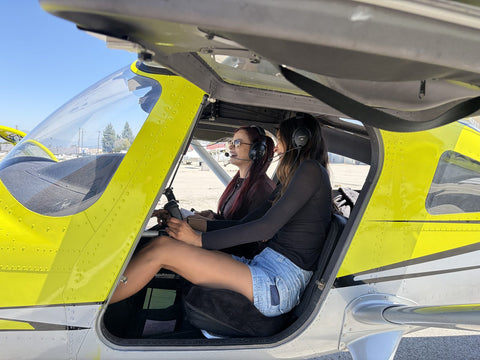
Pilots who have flown the Skycatcher tend to describe it in similar terms. It is light on the controls in a way a 172 is not, and the panel-mounted stick yokes take about five minutes to stop noticing. Visibility out of the high wing with the upward-opening doors is excellent, and on a warm day you can taxi with them open. It is quiet by light aircraft standards and the glass panel gives you more information than the trainer generation before it ever did.
It is also light, which cuts both ways. In smooth morning air it is a delight. In afternoon turbulence over the Valley it moves around more than a heavier airplane, and crosswind landings ask for attention because there is not much mass to help you. The stall is docile. The climb is adequate rather than exciting. And you plan every flight around the useful load, because with two adults aboard, fuel becomes the variable you trade against.
None of that is a criticism of the airplane so much as a description of what a 1,320-pound aircraft is. It does exactly what it was designed to do, cheaply. That the market decided it did not want to pay for it is a separate matter.
How The Skycatcher Compares To A Cessna 152, A Cessna 172 And A Diamond DA20
The Skycatcher is almost always considered against one of three other airplanes: the Cessna 152 it was meant to replace, the Cessna 172 that most people picture when they think "Cessna", and the Diamond DA20 that competes for the same two-seat training role. The published figures below are typical rather than definitive, and every one of them must be confirmed against the POH for the individual aircraft before flight.
| Cessna 162 Skycatcher | Cessna 152 | Cessna 172S | Diamond DA20-C1 | |
|---|---|---|---|---|
| Seats | 2 | 2 | 4 | 2 |
| Engine | Continental O-200-D, 100 hp | Lycoming O-235, 110 hp | Lycoming IO-360-L2A, 180 hp | Continental IO-240-B, 125 hp |
| Wing | High, strut-braced | High, strut-braced | High, strut-braced | Low, cantilever |
| Construction | Aluminum with composite fairings | Aluminum | Aluminum | Composite |
| Controls | Panel-mounted stick yokes | Conventional yoke | Conventional yoke | Center stick |
| Maximum gross weight | 1,320 lb | About 1,670 lb | About 2,550 lb | About 1,764 lb |
| Typical cruise | About 110 kt | About 105 kt | About 124 kt | About 138 kt |
| Panel as commonly delivered | Garmin G300 glass | Analogue instruments | Garmin G1000 glass | Analogue, often with a GPS |
| Category | Light sport | Normal category | Normal category | Normal category |
| Can a sport pilot fly it | Yes | No | No | No |
| Fleet availability today | Very small, scattered | Large | Very large | Moderate, common in training |
Against the Cessna 152. This is the comparison Cessna intended. The Skycatcher is lighter, more modern, has a glass panel, better visibility and lower fuel burn. The 152 has a more powerful engine, a higher gross weight, a considerably better useful load, a vastly larger fleet and a maintenance ecosystem that exists in every hangar in America. As an airplane to fly, most pilots prefer the Skycatcher. As an airplane to own, rent or keep flying for twenty years, the 152 wins on availability alone.
Against the Cessna 172. These are not really competitors. The 172 has four seats, nearly twice the horsepower, twice the gross weight and the range and load-carrying to be a traveling airplane. The Skycatcher has half the fuel burn, a lower hourly rate and the light sport regulatory advantages. If you need to carry three passengers or fly at night as a sport pilot, the answer is a 172 and a private pilot certificate.
Against the Diamond DA20-C1. The DA20 is the most direct competitor in the two-seat training role, and it is a faster, slicker airplane with a bubble canopy, a center stick and a composite airframe. It is not a light sport aircraft, so a sport pilot cannot fly it, and its lower wing and canopy give a different visibility picture — better forward and downward in the turn, worse straight up. We fly the DA20 at Van Nuys and have written it up in full on our Diamond DA20-C1 reference page. If you want the light sport medical route, the Skycatcher is the one of the two that offers it. If you want speed and efficiency and hold a private certificate, the DA20 is the better airplane.
Training In The Cessna 162 At Van Nuys
The Skycatcher is the light sport trainer in our fleet at Van Nuys, and the airplane our Sport Pilot course is flown in. That course is $8,400 for 28 program hours, 25 in the airplane and 3 in the full-motion simulator, with ground school and books included. The regulatory floor under 14 CFR 61.313 is 20 hours, including 15 hours of dual instruction and 5 hours solo; the extra hours are there because most people need them.
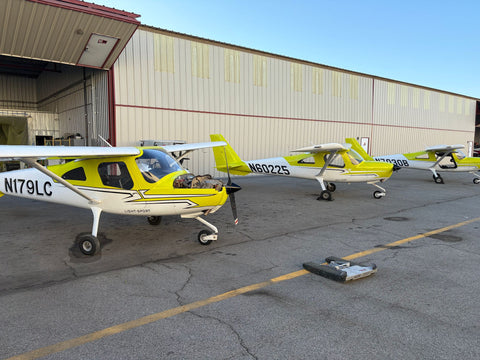
We fly six Skycatchers, and each has its own page with photos and rates: N7030B, N60225, N6039M, N179LC, N5208V and N52049.
Private pilot students fly it too. Every private pilot package flies the Cessna 162 and the Piper PA-28 Warrior at the standard rate of $179 an hour for the airplane and $110 an hour for instruction, and the Standard package is $10,400 for 40 hours. If you start on the sport route and later move up to the private certificate, the hours you logged in the Skycatcher still count. The two routes are compared on our sport pilot license page.
Compare the other airplanes we train in: the Piper Warrior PA-28-161, the Diamond DA20-C1, the Cirrus SR22 Turbo, the Piper Arrow and the Piper Seminole twin, or see the whole fleet.
Book A Free Consultation Call Or Text (818) 330-1318
Cessna 162 Skycatcher FAQ
Is The Cessna 162 Skycatcher Still In Production?
No. Cessna ended production in December 2013 after roughly 275 airframes were built, and in 2016 scrapped the unsold inventory rather than discounting it. The only Skycatchers available today are used aircraft, and the fleet is small and scattered.
Why Did Cessna Stop Making The Skycatcher?
A combination of a price that rose from around $110,000 at launch to roughly $149,000 by 2011, an empty weight that grew during development and left too little useful load inside the 1,320-pound light sport limit, a cramped cabin, controversy over airframe manufacture in China, and a light sport market that never reached the size the industry forecast in 2004.
Can A Sport Pilot Fly A Cessna 162?
Yes. The Skycatcher is a special light sport aircraft, so a sport pilot may fly it under the privileges and limits of 14 CFR 61.315 — day visual conditions, one passenger, no flight for compensation — and may use a valid US driver's license in place of an FAA medical certificate under 14 CFR 61.23, subject to the conditions of that rule. A private pilot with a current medical or BasicMed qualification can fly the same aircraft under broader privileges.
What Engine Does The Cessna 162 Have?
A Continental O-200-D: an air-cooled, carbureted, horizontally opposed four-cylinder of 200 cubic inches producing 100 horsepower, driving a two-blade fixed-pitch composite propeller. The O-200-D is a lightened development of the O-200 family used in the Cessna 150.
What Is The Cessna 162's Never Exceed Speed?
The published VNE is 148 KIAS, with a maximum structural cruising speed VNO of 124 KIAS and a maneuvering speed of 89 KIAS at the 1,320-pound gross weight, falling as weight reduces. Confirm every figure against the handbook for your serial number before flight.
How Many People Can A Cessna 162 Carry?
Two, side by side, and weight is the real limit rather than seating. With full fuel a typical Skycatcher has roughly 310 to 345 pounds of payload left, so two average adults and full tanks will often put the aircraft at or over its maximum takeoff weight. Most Skycatcher flying is done with partial fuel.
Did MOSAIC Change Anything For The Skycatcher?
Not for the aircraft itself. The Skycatcher was accepted as a special light sport aircraft under the ASTM standards in force in 2009 and remains one, and a sport pilot may still fly it on a driver's license. What MOSAIC changed is the context: since the sport pilot privilege changes of October 2025 and the certification changes of July 2026, light sport aircraft are defined by stall speed rather than by a 1,320-pound weight cap and may have up to four seats, so a sport pilot is no longer confined to airplanes with the Skycatcher's payload problem.
Where Can I Get A Cessna 162 POH?
From Textron Aviation's publications service or an authorized Cessna service center, ordered against the aircraft's serial number. We do not host or distribute it. An uncontrolled PDF found online carries no revision status and is a study aid at best; the handbook issued for that tail number, with its revisions current, is the authority for flight.
What Is The Useful Load Of A Cessna 162?
Typically about 450 to 490 pounds, depending on the individual airplane's empty weight. Full fuel of 24 gallons weighs about 144 pounds, which leaves roughly 310 to 340 pounds for two people and their bags. Use the weight and balance record for the actual tail number, never a typical figure.
Is The Cessna 162 A Good Trainer?
For lighter instructors and students, yes. It is docile at the stall, has excellent visibility and a simple glass panel, and burns roughly 5 to 6 gallons an hour. Its limits are payload and gusty afternoons, when its light weight makes it work harder than a four-seat trainer such as the Piper Warrior.
Can I Train In A Cessna 162 At Van Nuys?
Yes. Our $8,400 Sport Pilot course is flown in the Skycatcher, and private pilot packages fly it alongside the Piper Warrior at the standard $179 hourly aircraft rate. For checkouts and currency after your training, call or text (818) 330-1318.
Fly A Skycatcher At Van Nuys
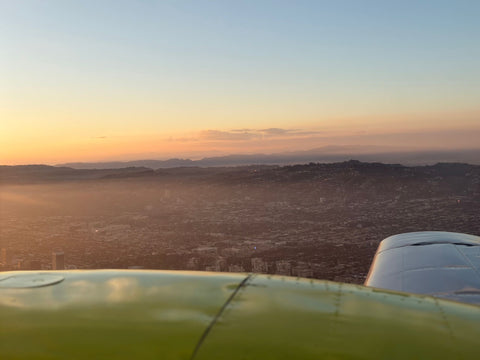
The honest answer to the question people arrive on this page asking is that Skycatchers are rare, and no operation in Los Angeles can promise you one on a given date. What we can tell you is what flying a light two-seat single is actually like, because that is what a discovery flight is: an hour in the pilot's seat of a real airplane at Van Nuys Airport with a certificated flight instructor beside you, for $229, with no certificate, no medical and no experience required. The type flown is confirmed on the day and we do not commit to a specific airplane in advance — but the handling, the visibility, the workload and the feel of a light single are the things you came here to understand, and every airplane on our ramp will teach you them.
If the light sport route is what brought you to this page, the sport pilot certificate is genuinely the cheapest path to flying an aircraft yourself, and it is one worth discussing before you commit to a private pilot syllabus. Call (818) 330-1318 and ask; we will tell you plainly which route fits what you actually want to do.
Fly At Van Nuys
Reading specifications only gets you so far. If you want to know what a light single actually feels like with your hands on the controls, a discovery flight is the fastest route — a real flight from Van Nuys Airport with a certificated flight instructor beside you, where you do the flying. It costs $229, takes about an hour, and requires no certificate, no medical and no experience. If you go on to train, the time is loggable.
Which airplane your flight uses is confirmed on the day; we do not commit to a specific type in advance. See The Airplanes You'll Fly for what is typically on the ramp, and our reference pages on the Piper Warrior PA-28-161, the Diamond DA20-C1 and the Cirrus SR20 and SR22. If you are curious about flying without an instructor once you are trained, call or text (818) 330-1318 to talk through checkouts and currency; our guide to aircraft rental at Van Nuys Airport explains what that involves, and our general guide to how aircraft rental works covers checkouts, wet and dry rates and what renting costs nationally. We run the certificate courses at Van Nuys, from the same field.
To fly first, book the 60-minute discovery flight in Los Angeles. If you are still working out what a discovery flight actually is, start with What Is A Discovery Flight? If the sport pilot route is what brought you here, the sport pilot certificate and how it compares with the private pilot certificate are explained in our guide to learning to fly in Los Angeles.
We are at Van Nuys Airport (KVNY) — 7900 Balboa Blvd, Main Terminal Unit 108, Van Nuys, CA 91406. Open 9 AM to 9 PM, seven days. Call (818) 330-1318.
Take The Controls Of A Real Airplane
An hour in the left seat over Los Angeles, from $229. No experience required, instructor included.
Book A Discovery Flight · $229Sources: 14 CFR 61.313, Aeronautical experience (sport pilot, airplane), and 14 CFR 61.23, Medical certificates, Title 14 of the Code of Federal Regulations on ecfr.gov, checked September 23, 2026.
