
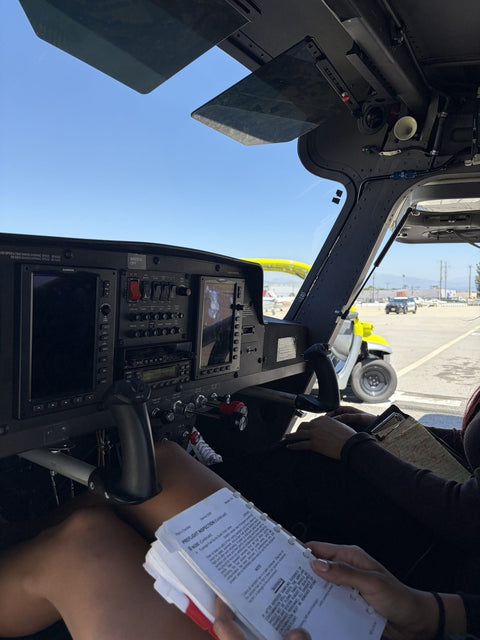
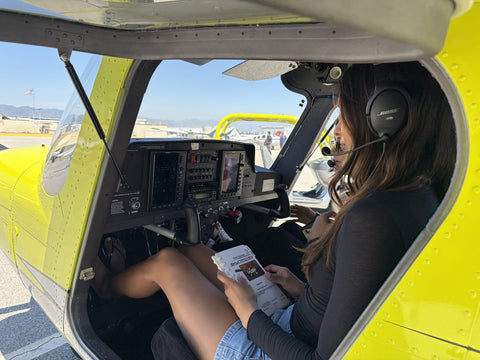
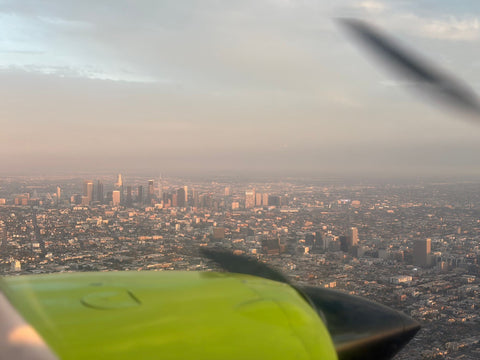


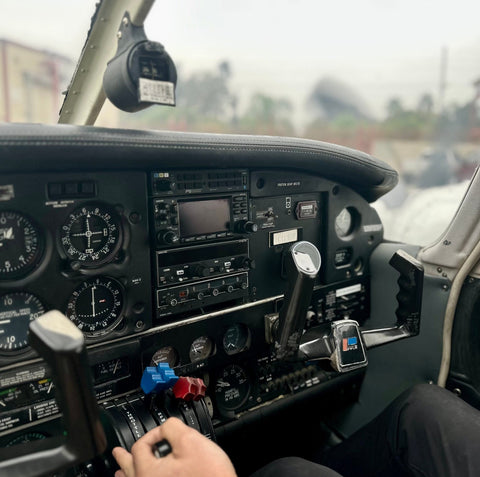
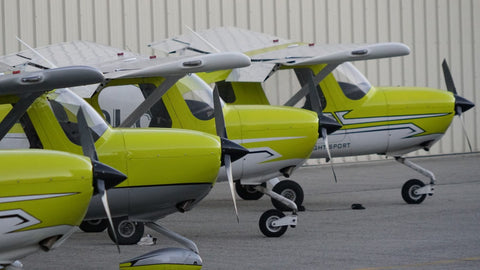


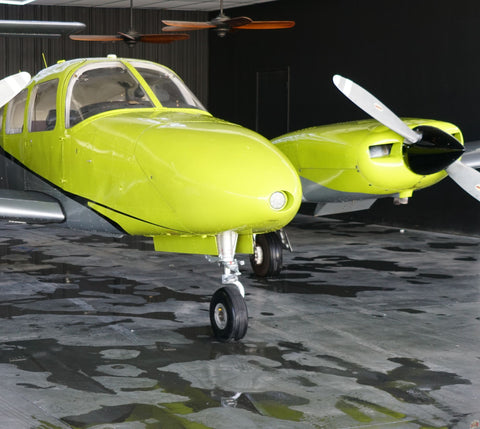

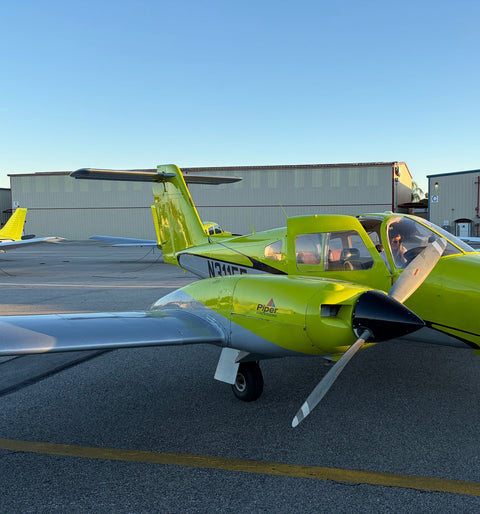


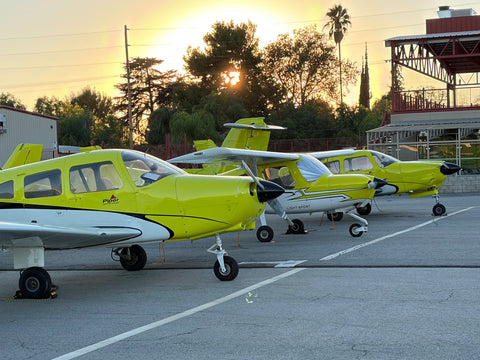
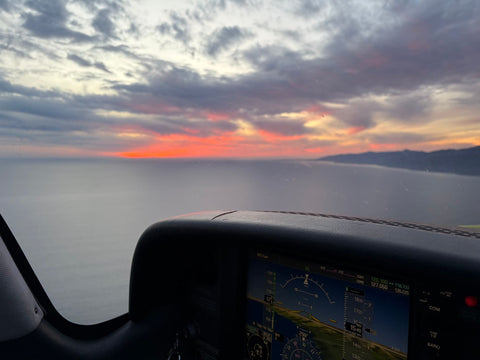
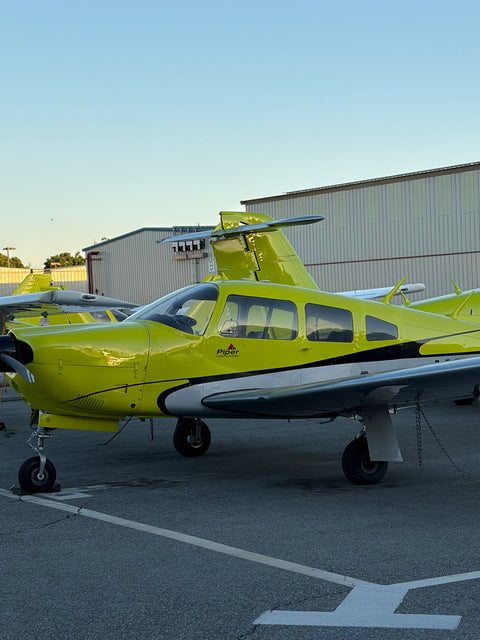
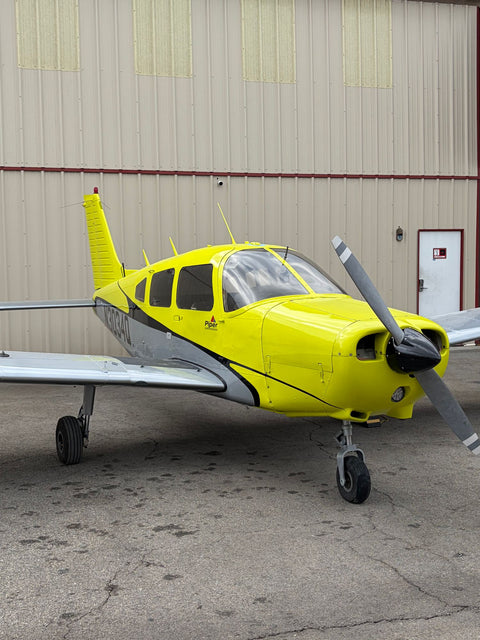

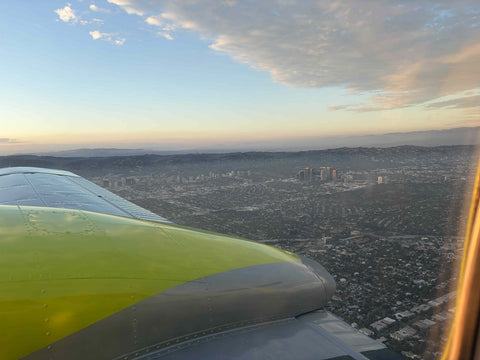




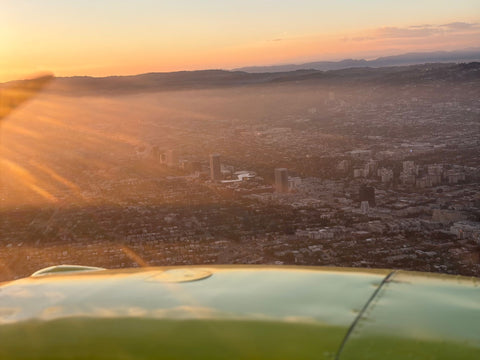
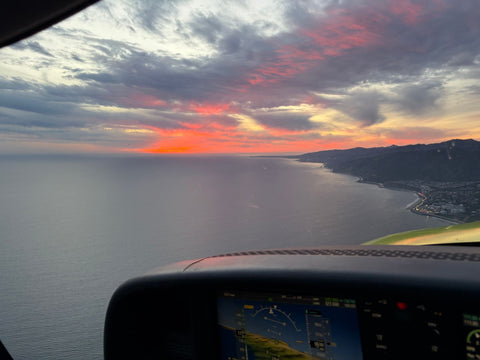


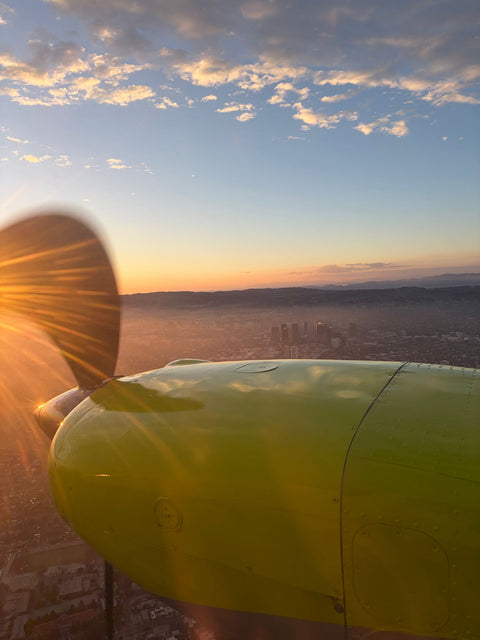




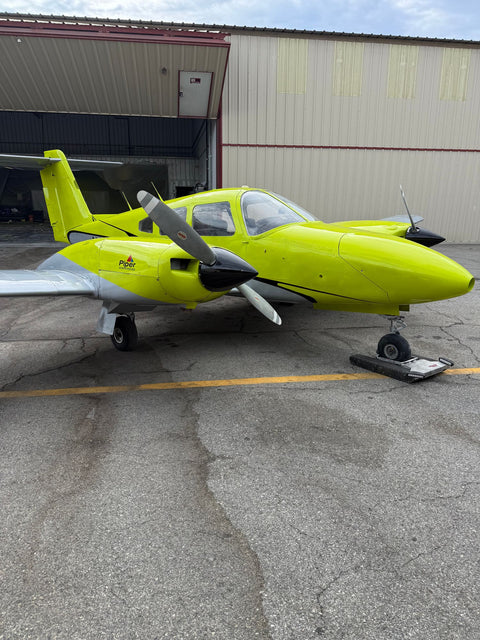
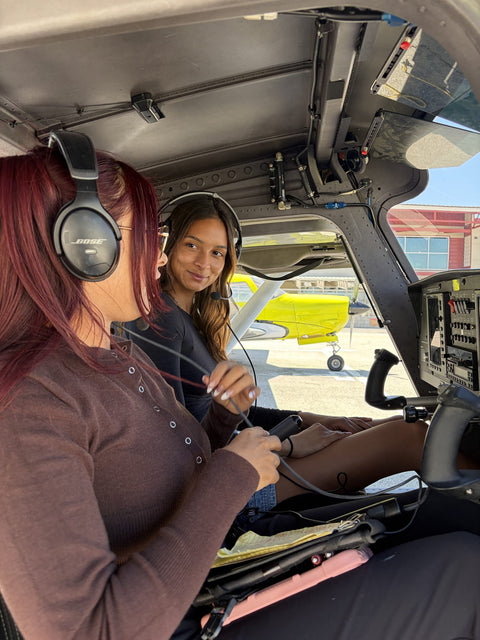
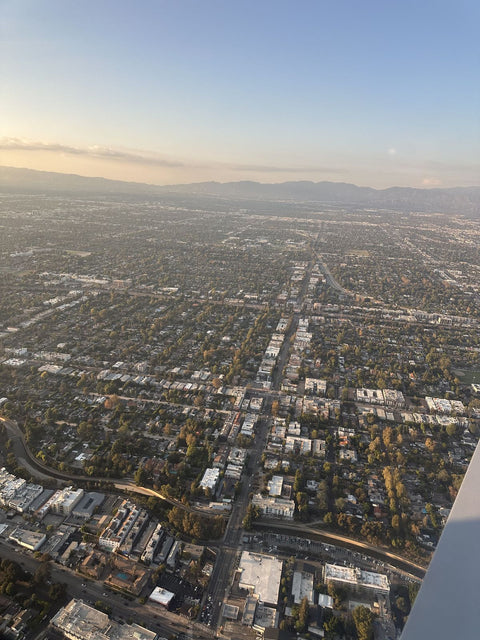
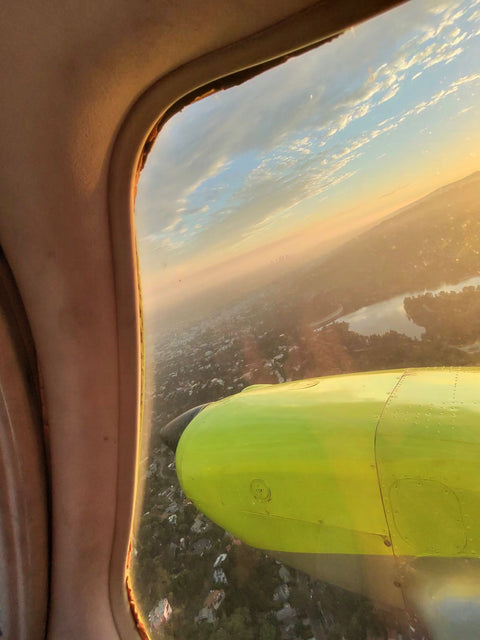


Van Nuys Airport is one of the busiest general aviation fields in the world, and a large share of the light airplanes parked on it are there to be rented by the hour. If you have searched for Van Nuys aircraft rental, you are probably somewhere between two questions: what does renting an airplane actually involve, and can I do it? This page answers both, honestly, including the aircraft on our own ramp and what they cost by the hour.
Read this first. You Fly LA flies discovery flights out of Van Nuys — an hour in the left seat of a real airplane with a certificated flight instructor beside you. We run the certificate courses, and a checkout in a specific airplane comes after the certificate; to talk through checkouts and currency, call or text (818) 330-1318. The FAA issues your certificate, not the school. Our instructors and aircraft are based on the Van Nuys ramp. This page exists because the question is a good one and most of the pages answering it are trying to sell you something. Ours is a guide.
Quick Answer: Van Nuys aircraft rental works much the same way at every operator on the field: you need a pilot certificate, a current medical or BasicMed, a flight review within the preceding 24 calendar months under 14 CFR 61.56, renter's insurance, and a checkout in the specific airplane with the operator's instructor. A checkout in a familiar type is usually a ground session and one to three hours of flying, billed as aircraft plus instructor time. If you do not hold a certificate yet, the first step is a $229 discovery flight.
Call Or Text (818) 330-1318 Book A Discovery Flight · $229
This page is about renting at Van Nuys specifically. For the general explanation of how aircraft rental works anywhere in the United States — checkouts, wet versus dry rates, Hobbs versus tach time, renter's insurance and national rate ranges by aircraft class — see Aircraft Rental: How Renting An Airplane Works.
What "Renting An Airplane" Actually Means
Renting a light airplane is not like renting a car, and the difference is not a formality. When you rent a car, the rental company checks that you hold a driver's license and takes a credit card. When you rent an airplane, the operator is putting a machine worth several hundred thousand dollars, and your life, into the hands of somebody they have to be satisfied is competent to fly it. So they check.
The mechanics are simple enough. Airplanes are rented by the hour, billed against a meter in the airplane — either the tachometer or a Hobbs meter — and you schedule them the way you would book a meeting room, through a web-based scheduling system the operator runs. You arrive, you preflight the airplane yourself, you fly it, you bring it back, you note the fuel and the times, and you are billed for the hours flown. Most operators require a minimum daily charge if you keep the airplane overnight, because an airplane sitting on a ramp in another state earns nothing.
What sits underneath that simplicity is a set of requirements that exist because insurance companies and the Federal Aviation Regulations both have opinions about who may act as pilot in command.
What A Checkout Actually Involves
Every rental operation runs a checkout. It is a flight, or a series of flights, with one of the operator's instructors, at the end of which they either sign you off to rent that airplane solo or tell you what more you need. Almost everywhere in the United States, the pieces look like this.
A Pilot Certificate
You need at least a sport pilot, recreational pilot or private pilot certificate to rent an airplane and fly it yourself. There is no rental path for someone with no certificate. A student pilot can fly a school's airplane solo, but only under an instructor's endorsement, in the specific make and model, and within the limits that instructor sets — which is a different arrangement from renting.
A Current Medical Certificate
Private pilot privileges require at least a third class medical certificate from an FAA-designated aviation medical examiner, or qualification under BasicMed, which is an alternative route available to pilots who have held a medical at some point since July 2006 and meet its conditions. Sport pilot privileges can be exercised on a valid US driver's license in place of a medical, subject to the sport pilot rules.
A Current Flight Review
Under the regulations, no pilot may act as pilot in command unless they have completed a flight review with an authorized instructor within the preceding 24 calendar months. It is not a test you can fail in the sense of losing your certificate — the instructor either signs your logbook or gives you more training until they can — but no operator will rent to you without a current one.
Currency For What You Intend To Do
If you plan to carry passengers, you need three takeoffs and landings in the preceding 90 days in the same category and class, and at night the landings must be to a full stop and flown between one hour after sunset and one hour before sunrise. If you intend to fly in instrument conditions, instrument currency is its own separate set of requirements.
A Checkout With That Operator, In That Airplane
This is the part most people underestimate. Being a private pilot does not entitle you to rent any airplane anywhere. Every operator has its own checkout standard, usually written into its insurance policy: a minimum total time, a minimum time in make and model, a ground session on the aircraft's systems and the operator's procedures, and a flight where an instructor watches you do the things that break airplanes — crosswind landings, short field work, slow flight, stalls, a simulated engine failure, and the local airspace. Expect one to three hours of flying for a familiar type, more if the airplane is new to you.
Checkouts are also usually type-specific and currency-limited. If you check out in a Piper and then want the Cirrus, that is a second checkout. If you do not fly the airplane for 60 or 90 days, many operators require a short recheck before you take it again.
Insurance
The operator carries hull and liability insurance on the airplane, but that policy protects the operator, not you. Most rental agreements make the renter responsible for a deductible, which on a light single is commonly a few thousand dollars and on a higher-performance airplane can be considerably more. Renter's insurance is a separate, inexpensive policy you buy yourself that covers that deductible and gives you your own liability coverage. Experienced renters treat it as non-optional. It typically costs a few hundred dollars a year, which is less than one hour of flying, and it is the cheapest peace of mind in aviation.
Are You Ready For A Checkout?
Tick what is true today. Anything left unticked is what the checkout, or a flight review before it, will spend its time on.
- You hold a sport, recreational or private pilot certificate.
- Your medical certificate is current, or you fly under BasicMed or as a sport pilot on a driver's license.
- Your last flight review was within the preceding 24 calendar months (14 CFR 61.56).
- You have made three takeoffs and landings in the preceding 90 days, if you plan to carry passengers (14 CFR 61.57(a)).
- For passengers at night, you have made three night takeoffs and landings in those 90 days, each landing brought to a complete halt rather than a touch-and-go (14 CFR 61.57(b)).
- You hold the endorsements the airplane needs: complex for retractable gear, flaps and a controllable-pitch propeller, high performance for more than 200 horsepower (14 CFR 61.31(e) and (f)).
- You have renter's insurance in place.
- You have read the airplane's handbook and know its V-speeds, fuel system and limitations before you arrive.
How Much It Costs To Rent An Airplane
Rental rates are quoted in two ways, and confusing them is the single most common reason a first bill surprises somebody.
| Term | What It Means |
|---|---|
| Wet rate | Fuel and oil are included in the hourly price. You fill the airplane before you return it, or the operator bills the fuel back at cost. Most flight schools quote wet. |
| Dry rate | Fuel is not included. The hourly number looks lower, and then you buy the avgas yourself. Common with flying clubs and partnerships. |
| Hobbs time | A meter that runs whenever the master switch or oil pressure is on. Counts taxi and run-up time. Runs faster than tach time. |
| Tach time | A meter geared to engine rpm that runs at rated speed only at cruise power and slower on the ground. Usually the cheaper of the two for the renter. |
Los Angeles is an expensive market. Hangar and tiedown costs at a field like Van Nuys are among the highest in the country, avgas in Southern California is well above the national average, insurance for a training fleet in dense airspace is expensive, and maintenance labor rates reflect the local cost of everything else. All of that lands in the hourly rate.
As a general picture rather than a quote, a two-seat light trainer in Los Angeles is usually the cheapest thing on the ramp, a four-seat fixed-gear single such as a Piper Warrior or a Cessna 172 sits a step above it, and a modern glass-panel Cirrus is substantially more again — often close to double the Warrior. Add an instructor and you are paying an additional hourly rate on top. Rates move with the price of fuel and are revised more often than most operators update their websites, so the only number that matters is the one the operator gives you in writing this week.
The things that drive the price are worth knowing, because they explain why two airplanes that look identical are not priced the same:
- Fuel burn. A 100-horsepower two-seater burns roughly half what a 200-horsepower four-seater does, and avgas is the largest single variable cost.
- Engine reserve. Operators set aside a fixed amount per hour toward the eventual overhaul. A bigger, more complex engine has a bigger reserve.
- Avionics. A glass panel with a modern navigator, autopilot and traffic system costs more to buy, insure, update and repair than a pair of steam gauges.
- Insurance. Retractable gear, high performance and expensive airframes all raise the premium, and the premium is spread across the hours flown.
- How much the airplane flies. Hangar, annual inspection and insurance are fixed whether the aircraft moves or not, so they get spread across the hours it does fly. A busy airplane can be cheaper per hour than an idle one.
Where you see old rental prices for this airport quoted elsewhere on the internet, treat them as history. They are not our prices, they are not current, and nobody is renting at them today.
Before the hourly rates below mean anything, we need to know what you are checked out in. A free consultation covers the checkout, the currency you would need and what you want to do with the airplane.
Hourly Aircraft Rates At Van Nuys (2026)
Because a guide that refuses to name a number is not much of a guide, here are the hourly package rates for the aircraft on our own ramp at Van Nuys Airport. They are per hour on the meter, and every airplane below needs a checkout with one of our instructors before anyone acts as pilot in command; call or text (818) 330-1318 to talk through checkouts and currency.
| Aircraft Or Service | Hourly Rate | Notes |
|---|---|---|
| Piper Warrior PA-28-161 or Cessna (standard trainer) | $179 | Four-seat fixed-gear single; checkout required |
| Diamond DA20-C1 | $229 | Standard rate plus $50; two-seat composite trainer; checkout required |
| Cirrus SR22T | $579 | Standard rate plus the $400 Cirrus upgrade; glass cockpit and CAPS; Cirrus transition training and checkout required |
| Piper Arrow PA-28R | Part of the $15,400 commercial course | Four-seat complex single: retractable gear, constant-speed propeller; complex endorsement and checkout required |
| Flight instructor (dual instruction) | $110 | Added to the aircraft rate for checkouts, flight reviews and lessons |
| Ground instruction | $110 | One-on-one, billed per hour |
| Full-motion flight simulator | $120 | Plus instructor when flown as a lesson; no weight limit, no weather |
Two practical notes. A checkout is not a hidden fee; it is simply aircraft time plus instructor time at the rates above, so a typical two-hour Warrior checkout costs about $578, and a Cirrus transition course is a multi-day commitment priced the same way. And if you have not flown in a while, budget for a flight review at the same aircraft-plus-instructor rate before any operator will hand you the keys. Rates are reviewed as fuel and insurance costs change; confirm the current figure when you call.
The Airplanes You Would Typically Rent
The light aircraft on a training ramp in Los Angeles are mostly drawn from a small, well-understood group. We have written detailed reference pages on several of them.
Piper PA-28-161 Warrior
A four-seat, low-wing, fixed-gear single with a 160-horsepower carbureted Lycoming and manual flaps. Stable, forgiving, mechanically simple, and the airplane an enormous share of American pilots learned in. Not fast — about 115 to 120 knots true — but honest and cheap to run. Full detail on our Piper Warrior PA-28-161 reference page.
Diamond DA20-C1
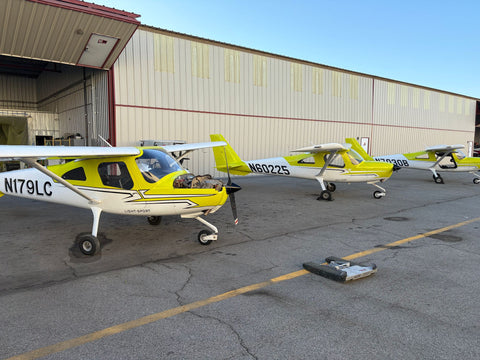
A two-seat composite trainer with a bubble canopy, a control stick instead of a yoke, and visibility that ruins you for anything else. Efficient, light on the controls, and a common sight in Southern California training fleets. See our Diamond DA20-C1 reference page.
Cirrus SR20 And SR22
Four-seat composite singles with full glass panels, side yoke controls, and the whole-airframe parachute system that made the type famous. They are faster, more capable and more complex than a Warrior, and every operator that rents them requires a dedicated transition course before you fly one solo — the manufacturer's standardized training is the norm, not a formality. Detail on our Cirrus SR20 and SR22 reference page.
Cessna 162 Skycatcher
A two-seat light sport aircraft built briefly around 2009 to 2013 with a 100-horsepower Continental O-200D. Cessna discontinued it and relatively few were built, so you will not find them everywhere, but they turn up in light sport rental fleets and they are one of the cheapest ways to fly. Our Cessna 162 Skycatcher reference page covers it in full.
For an overview of what we fly on our own discovery flights, see The Airplanes You'll Fly.
What To Look For In A Rental Operation
Not all rental operations are the same, and the differences show up in ways that cost you money and lessons rather than in the advertised rate. Before you commit to a checkout, look at the following.
- Maintenance. Ask who maintains the fleet, whether it is in-house or contracted, and how squawks are reported and tracked. A well-run operation has a written squawk process and pulls airplanes off the line rather than flying them with deferred items. Look at the airplanes: worn tires, oily bellies, cracked interior plastic and taped-over inoperative placards tell you what the operator's standards are.
- Dispatch and scheduling. A modern online scheduler, clear rules about cancellations and no-shows, and a real person on the desk who can rebook you when an airplane goes unserviceable. The most common complaint about any rental fleet is not price, it is availability.
- Fleet depth. If the operator has one of a type and it goes into an annual inspection, your flying stops. Several of the same type means a swap rather than a cancellation.
- Fuel policy. Wet or dry, whether you are expected to return it full, whether fuel bought away from base is reimbursed, and at what price. Get this in writing before your first cross-country.
- Minimums and overnight rules. Daily minimum hours for overnight trips vary widely and are the difference between a weekend away being affordable and not.
- Checkout and recheck policy. How long a checkout takes, what it costs, how many days of inactivity trigger a recheck, and whether a checkout in one type carries any credit toward another.
- Instructor availability. Even after checkout, you will want an instructor occasionally — for a flight review, an endorsement, or a rusty return to flying. An operation with a thin instructor bench makes that hard.
Where To Fly And Train At Van Nuys
If you hold a certificate and you want to fly at Van Nuys, call or text (818) 330-1318 and we will talk through the aircraft, the checkout and the currency you would need. If you do not hold a certificate yet, we run the courses that get you one — private, instrument, commercial and multi-engine — and a checkout in a specific airplane comes after the certificate. For the wider picture, renting a plane in Los Angeles covers who rents what across the metro, Cirrus SR22 rental covers the high-performance end of that market, and time building at Van Nuys explains what most of those rented hours are actually for.
If you are earlier in the process than that, the sensible first step is a discovery flight. It costs $229, takes about an hour, needs no certificate, no medical and no paperwork, and you do the flying with a certificated flight instructor beside you. It is the cheapest honest way to find out whether the rest of this is for you before you spend money on training. The time is loggable if you go on to train.
Related reading: Private Pilot License In Los Angeles for what earning the certificate involves, Flight Training At Van Nuys Airport for what learning here is like, and Flying Out Of Van Nuys Airport for the field itself.
Common Questions About Aircraft Rental
Can I Rent An Airplane Without A Pilot License?
No. You need at least a sport, recreational or private pilot certificate to rent an airplane and fly it as pilot in command. What you can do without any certificate is book a discovery flight, where a certificated flight instructor is legally the pilot in command and you do the flying.
Which Aircraft Do You Fly At Van Nuys, And At What Rate?
Piper Warriors and Cessna 162 Skycatchers at $179 an hour, the Diamond DA20-C1 at $229 and the Cirrus SR22 Turbo at $579, all at the hourly package rate, plus $110 an hour for an instructor. The Piper Arrow is part of the $15,400 commercial course and the Piper Seminole is part of the $5,100 multi-engine package. Call or text (818) 330-1318 to talk through checkouts and currency.
How Long Does A Checkout Take?
For a current pilot in a familiar type, commonly a ground session plus one to three hours of flying. For an unfamiliar or higher-performance airplane, such as a Cirrus, expect a structured transition course measured in days rather than hours. Each operator sets its own standard, driven largely by its insurance policy.
What Is The Difference Between A Wet Rate And A Dry Rate?
A wet rate includes fuel and oil in the hourly price. A dry rate does not, and you buy the fuel separately. A dry number always looks cheaper and rarely is once you add avgas at Los Angeles prices.
Do I Need Renter's Insurance?
It is not legally required, but you should have it. The operator's insurance protects the operator. Most rental agreements hold you liable for a deductible that can run into thousands of dollars, and renter's insurance covers that plus your own liability for a few hundred dollars a year.
Can I Take A Rental Airplane On An Overnight Trip?
Usually yes, subject to a daily minimum number of billed hours and to the operator's approval. Ask about the minimum, the fuel reimbursement policy away from base, and what happens if weather strands you — that last one is a real conversation, and the right answer from an operator is that you do not fly home in weather you should not be in.
How Much Total Time Do Operators Require Before They Rent To Me?
It varies with the airplane and the insurer. A basic four-seat trainer often needs relatively little beyond a certificate and a satisfactory checkout. Higher-performance and glass-panel airplanes carry minimum total time and minimum time in type requirements set by the underwriter, and no amount of persuading the operator changes them.
Is A Flying Club Cheaper Than Renting From A School?
Often, per hour, yes — clubs typically quote dry rates and spread fixed costs across members, and they usually charge an initiation fee and monthly dues. Whether that comes out cheaper depends entirely on how much you fly. Below a few hours a month, straightforward hourly rental is usually simpler and no more expensive.
What Is The Cheapest Way To Fly Regularly In Los Angeles?
Broadly, a two-seat light sport aircraft rented dry through a club, flown often enough to spread the fixed costs. Broadly, the most expensive is an infrequently flown, high-performance single rented wet from a full-service operation. Most people end up somewhere in between and decide based on what they actually want to do with the airplane.
I Have Not Flown In Years. Where Do I Start?
With a flight review. Book an instructor, fly a couple of hours, and let them tell you what needs work. Rental checkouts and currency follow from there. Plenty of people also book a discovery flight first, simply to sit in an airplane again and see how it feels before committing to anything.
What Endorsements Do I Need To Rent A Cirrus Or A Piper Arrow?
A high-performance endorsement for any airplane with an engine of more than 200 horsepower, such as the Cirrus SR22, and a complex endorsement for an airplane with retractable gear, flaps and a controllable-pitch propeller, such as the Piper Arrow. Both are one-time logbook endorsements from an instructor under 14 CFR 61.31(e) and (f), and operators add their own transition training on top.
How Recent Does My Flying Need To Be To Rent?
To act as pilot in command at all you need a flight review within the preceding 24 calendar months under 14 CFR 61.56. To carry passengers you also need three takeoffs and landings in the preceding 90 days under 61.57(a), and for passengers at night three night landings, none of them touch-and-goes, under 61.57(b). Many operators add their own recheck if you have not flown their airplane for 60 or 90 days.
Find Us At Van Nuys
We operate from Van Nuys Airport (KVNY) in the San Fernando Valley — 7900 Balboa Blvd, Main Terminal Unit 108, Van Nuys, CA 91406. Open 9 AM to 9 PM, seven days a week. Call (818) 330-1318 with questions, or book a free consultation if you would rather talk it through before booking anything.
Call Or Text (818) 330-1318 Book A Free Consultation
Start With The Flight, Not The Paperwork
An hour in the left seat over Los Angeles, from $229. No certificate, no medical, no experience needed.
Book A Discovery Flight · $229Sources: 14 CFR 61.31(e) and (f) (complex and high-performance endorsements), 14 CFR 61.56 (flight review) and 14 CFR 61.57 (recent flight experience), Title 14 of the Code of Federal Regulations on ecfr.gov, checked September 23, 2026.