
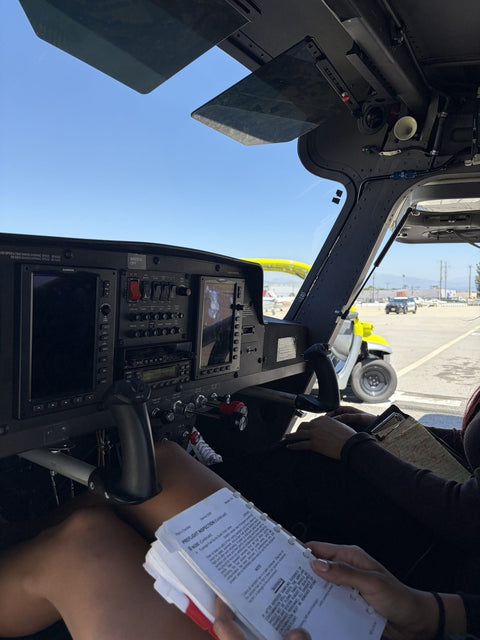
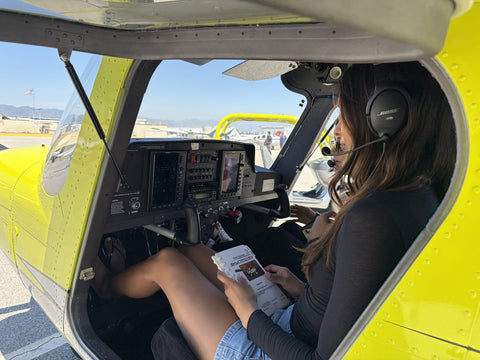


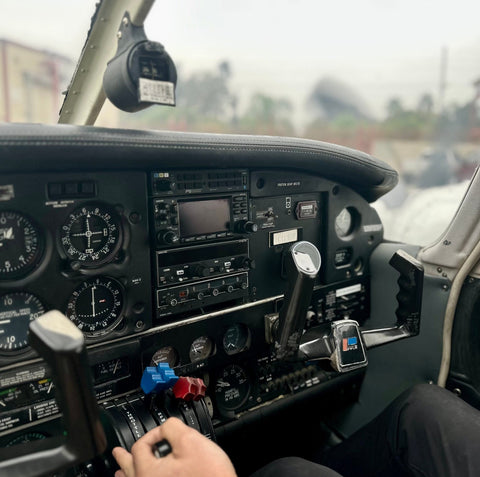
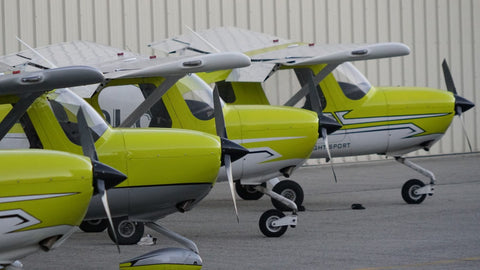


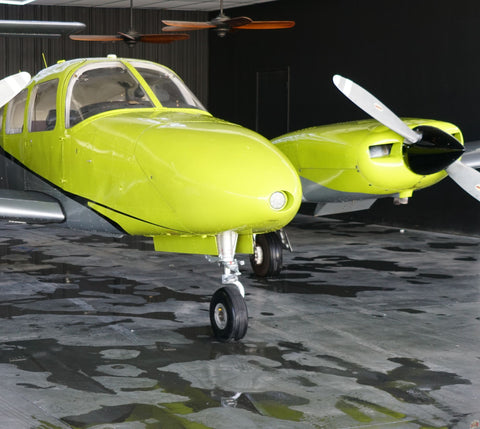

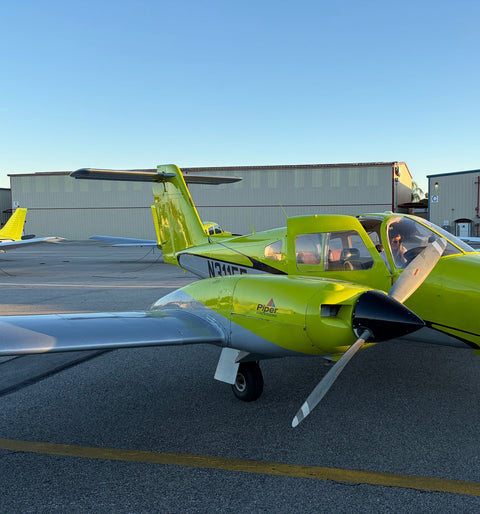


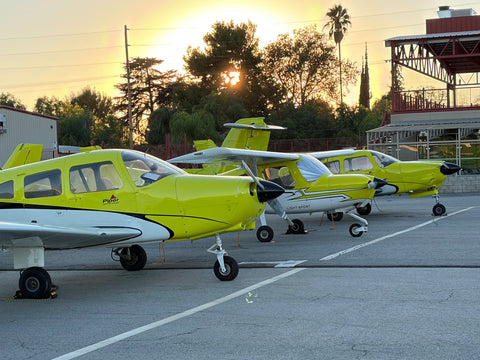
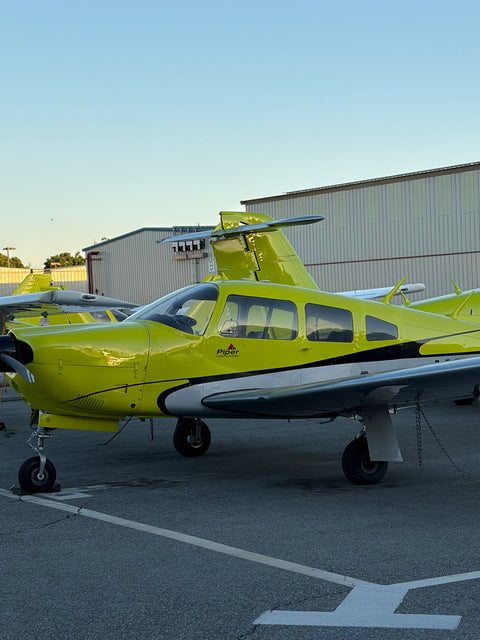
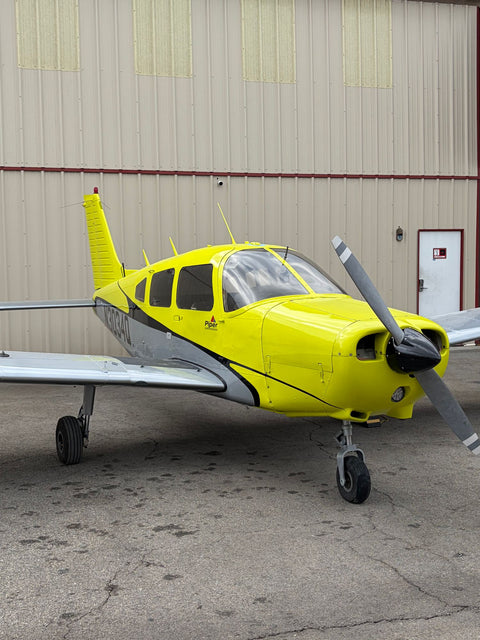











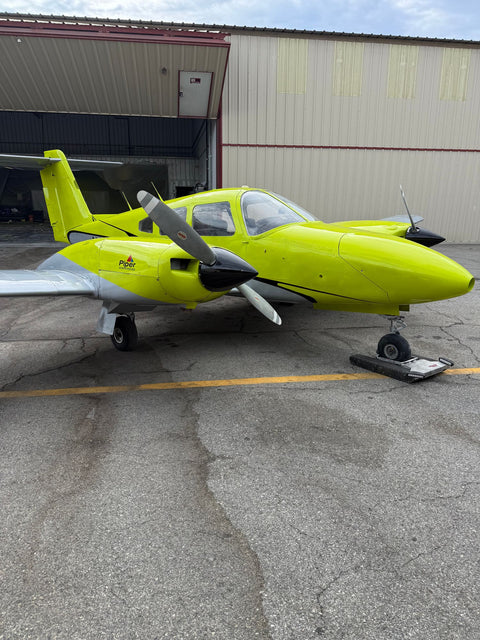
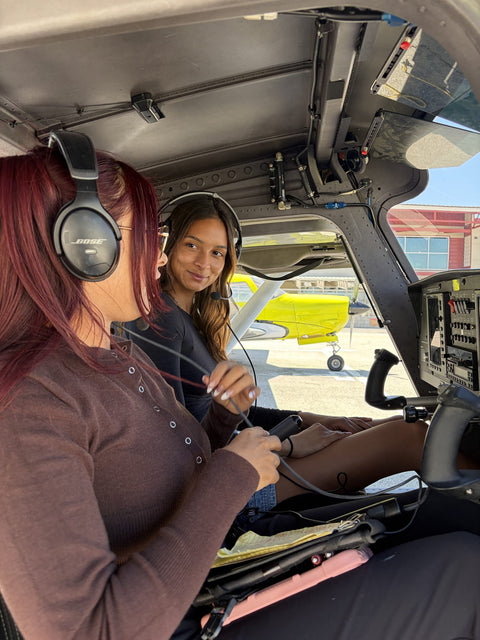


The multi-engine rating cost at Van Nuys is $5,100. That price covers eight hours in the Piper Seminole, two hours in the Redbird MCX full-motion simulator, ten hours of flight instruction, two hours of ground instruction and your books and materials. The examiner is the only significant item outside it, at roughly $800 to $1,000 paid directly to them on the day.
This page shows what is inside that number, line by line, and what sits outside it. For the rating itself, see multi-engine rating requirements; for where this sits among every other training price we publish, see how much flight school costs.
Book A Free Consultation Call Or Text (818) 330-1318

Why The Seminole Is Sold As A Package
The Seminole has no separate hourly rate. Its hours are part of the $5,100 multi-engine package, where the schedule, the syllabus and the airplane are committed in advance. Every rate we publish is a package rate, and all of them are wet, meaning fuel is included.
The reason is utilization. A twin that sits on the ramp while somebody decides whether the weather is good enough still costs hangar space, insurance, an engine reserve and a maintenance schedule. A twin that is booked for eight hours across a known week earns its keep, and a fixed course price reflects that.
Why Twin Time Costs What It Costs
Pilots regularly ask why twin time costs so much more than time in a Warrior when the airplane does not look that different. The honest answer is that almost every cost in operating a light twin is doubled or worse.
- Two engines. Two overhauls to reserve for, two sets of cylinders, two oil changes, two sets of magnetos, two starters and two alternators. Engine reserve alone is the single biggest line in a twin's hourly cost.
- Two constant-speed propellers. Feathering propellers are more complex than fixed-pitch units, they have their own overhaul intervals, and they are not cheap.
- Fuel burn. Two 180-horsepower engines burn roughly twice what one 160-horsepower engine burns, and the rate is wet, so that fuel is inside the number you see.
- Retractable landing gear. More moving parts, more inspection, more to go wrong.
- Insurance. Twin hull values and twin liability exposure are in a different bracket, and a training twin flown by pilots who are learning engine-out procedures is priced accordingly.
- Downtime. When the Seminole is in maintenance, it is not earning revenue, and that has to be priced in across the year.
None of that is unique to us. It is why every school in the country charges a large premium for twin time, and why the multi-engine rating is deliberately structured as the shortest course in the professional sequence.
The $5,100, Line By Line
Here is what the course contains. The simulator, instruction and ground are shown at our published package rates; the Seminole has no separate hourly rate and is inside the fixed price.
| Component | Hours | Rate | Subtotal |
|---|---|---|---|
| Piper Seminole | 8 | Part of the package | Included |
| Full-motion simulator | 2 | $120 | $240 |
| Flight instruction | 10 | $110 | $1,100 |
| Ground instruction | 2 | $110 | $220 |
| Books and materials | — | — | Included |
| Course price | $5,100 |
The Seminole hours, its fuel and the books all come inside the one fixed price, which is the number that matters when you compare schools.
Why Not Assemble It Hour By Hour
Because a twin rewards continuity more than any other rating. Engine-out handling learned on a Tuesday is still sharp on a Friday, and it is not after a two-week gap. If you take nothing else from this page, take that: pilots who try to assemble a multi-engine rating a weekend at a time usually need more hours and end up paying more for a worse result, which is why the rating is sold as a fixed seven-day course.
What Sits Outside The Price
| Item | Typical cost | Notes |
|---|---|---|
| Designated pilot examiner fee | Roughly $800 to $1,000 | Paid directly to the examiner. Ask when you book; fees vary between examiners and move over time. |
| FAA knowledge test | $0 | No written is required for an added class rating under 14 CFR 61.63(c). |
| Medical certificate | Varies by examiner | Only if yours has lapsed. Adding a class rating does not change the class of medical you need. |
| Extra Seminole dual, if needed | Confirmed before you fly it | Seminole time plus the instructor at $110 an hour; rare on the seven-day schedule. |
| Instrument tasks on the checkride | Usually an extra session | Worth it if you hold an instrument rating. Skipping it means a VFR-only multi-engine limitation and a second checkride later. |
| Accommodation and travel | Varies | Relevant if you are flying in for the seven-day course. |
Budget realistically at $5,900 to $6,100 all in for a pilot who completes the course in the scheduled hours and pays a $800 to $1,000 examiner fee. That is the number to compare against other schools, and it is the number most quotes leave out.
If You Need More Hours, Or The Ride Does Not Go Your Way
Two honest scenarios, because both happen and neither is in the headline price.
Needing more than eight hours. The eight hours in the package is what most pilots flying the seven-day schedule actually use. Pilots who have not flown in six months, or who are adding multi-engine at commercial tolerances rather than private, sometimes want an extra hour or two. That is Seminole time plus the instructor at $110 an hour, confirmed with you in advance, and your instructor will tell you it is coming well before the last day rather than on it. Nobody is sent to a checkride that is not going to go well to protect a package price.
A partial or unsatisfactory result. If the practical test does not go your way, the retest covers only the areas of operation that were not satisfactory, which is usually short. What it does cost is a second examiner fee and whatever remedial flying you need. There is no penalty from us. The reason we schedule a mock oral with a second instructor before the ride is that the oral, not the flying, is what catches most multi-engine candidates out, and it is much cheaper to find that out on the Friday.
How To Pay For It
The published plan is $2,500 down and two payments of $1,300. We also run interest-free direct payments over up to twelve months, and Stratus Financial arranges terms up to fifteen years with a soft credit check for pilots financing a longer training path. Details are on our flight training financing page.
Book A Free Consultation Call Or Text (818) 330-1318

Why Two Hours Of It Are In A Simulator
The simulator is not a cost-cutting substitute for the airplane, although it does cost far less per hour. It is a better place to practice the two maneuvers you most need and least want to rehearse repeatedly at low altitude: a rejected takeoff, and an engine failure immediately after liftoff. In the Redbird you can fail an engine at fifty feet, mishandle it, freeze the scene and talk about what happened. In the airplane you cannot. Doing that work first means the airplane hours are spent flying rather than being surprised, which is precisely why eight hours is enough.
How It Compares With Our Other Courses
| Course | Price |
|---|---|
| Multi-engine rating | $5,100 |
| Instrument rating | $11,700 |
| Commercial pilot | $15,400 |
| Flight instructor program, CFI plus CFII plus MEI | $15,400 |
| Private pilot, Standard | $10,400 |
| Airline Pilot Career Program | $84,000 |
The multi-engine rating is the cheapest rating in the professional sequence and by some distance the fastest. It is the only one measured in days rather than months, and the only one with no knowledge test attached. Full price comparisons across every certificate are on our flight school cost breakdown for Los Angeles.
How To Compare A Quote From Another School
Multi-engine quotes are unusually easy to make look cheap, because the two largest variables are both easy to leave out. Ask every school the same six questions and write the answers down.
- How many hours in the airplane does the price include, and what happens after that? A quote built on six hours at a low rate is more expensive than a quote built on eight at a higher one if you need eight. Ask for the per-hour overrun figure in writing.
- Is the instructor included in the aircraft rate, or added? Some schools quote a dry or aircraft-only rate and bill instruction separately. Ours is one fixed $5,100 covering the airplane, the simulator, the instructor and ground, with instruction stated at $110 an hour.
- Wet or dry? A dry rate with fuel on top is not comparable to a wet rate, and twin fuel burn is substantial.
- Is the examiner fee included? It almost never is, anywhere. Ask the number anyway, because examiner fees vary and it is $800 to $1,000 of your budget.
- Is it a conventional twin or a centerline-thrust twin? A rating earned in a centerline-thrust airplane is issued with a centerline-thrust limitation, and removing it later means another course and another checkride. The Seminole is conventional.
- Are the instrument tasks included in the checkride? If you hold an instrument rating and they are not, you will be issued a VFR-only multi-engine limitation and pay a second examiner to remove it.
A school that answers all six plainly is quoting you a real number. One that will not put the overrun rate in writing is quoting you a deposit.
Is The Rating Worth $5,100?
It depends entirely on what you are doing with it, and we would rather say that than sell it to everybody.
If you are building a career, it is not optional and it is cheap. Every regional and charter operator flies multi-engine equipment, and 14 CFR 61.159(a) requires 50 hours in the class of airplane for an ATP with a multi-engine rating. Against an $84,000 career path, $5,100 for the rating that gets you into that seat is a rounding error, and doing it early means those 50 hours accumulate over years rather than being bought in a block later. Our multi-engine time building page sets out what that alternative looks like.
If you are buying into a twin, it is the cheapest part of the decision. Your insurer will want more training than the FAA does, and the rating is the entry ticket to that conversation.
If you fly a single for pleasure twice a month, think harder. A twin is only safer than a single in the hands of a pilot who stays current in it, and staying current in a twin costs real money every year. The rating itself will make you a sharper pilot, which is a genuine benefit, but it is an expensive way to buy that alone. If that is your motivation, a thorough flight review or an instrument rating will do more for your flying per dollar.
Where People Spend More Than They Planned
- Skipping the instrument tasks. A second practical test to remove a VFR-only multi-engine limitation costs another examiner fee and another day in the airplane. Include the tasks the first time.
- Training a weekend at a time. Engine-out handling decays between sessions. Every gap of more than a week costs roughly a warm-up circuit in the Seminole.
- Arriving unprepared. Ground instruction is $110 an hour, and time spent teaching you the fuel system that you could have read at home is time not spent flying.
- Not asking the examiner fee in advance. It is the one number nobody publishes and it varies. Ask when the ride is booked.
- Booking around a job. A course designed for seven consecutive days and then flown across six weeks is a different, more expensive course. Take the week if you possibly can.
Related Reading
- Multi-engine rating requirements — what 14 CFR 61.63(c) asks for and what the checkride covers.
- Accelerated multi-engine rating — the seven-day schedule that keeps the hours at eight.
- Multi-engine rating in Los Angeles — the local course page.
- How much does flight school cost — every certificate, every rating, one page.
- Flight training financing — payment plans and Stratus Financial.
- Multi-engine time building — how twin hours are built and logged once you hold the rating.
Multi-Engine Rating Cost FAQ
How Much Does A Multi-Engine Rating Cost?
Our course is $5,100 and covers eight hours in the Piper Seminole, two hours of full-motion simulator, ten hours of flight instruction, two hours of ground and your materials. Add roughly $800 to $1,000 for the examiner, so budget $5,900 to $6,100 all in.
Why Is The Seminole More Expensive Than A Single?
Two engines, two constant-speed propellers, retractable gear, roughly double the fuel burn and twin-bracket insurance. A Warrior or Skycatcher is $179 an hour wet at the package rate; the Seminole has no separate hourly rate and is flown as part of the $5,100 multi-engine package.
Is The Examiner Fee Included?
No. The designated pilot examiner is independent and is paid directly by you on the day of the practical test, typically $800 to $1,000. Ask for the exact figure when the ride is booked.
Is There A Written Exam Fee?
No. An added class rating requires no FAA knowledge test under 14 CFR 61.63(c), so there is no testing center fee at all for this rating.
What If I Need More Than Eight Hours?
Most pilots flying the seven-day course finish inside the eight hours. If you need more, it is Seminole time plus the instructor at $110 an hour, and we confirm the figure with you before you fly it.
Can I Pay In Installments?
Yes. The published plan is $2,500 down and two payments of $1,300. Interest-free direct payments over up to twelve months and Stratus Financial over longer terms are both available.
Is It Cheaper To Rent The Twin And Find My Own Instructor?
The Seminole has no separate hourly rate: it is flown as part of the $5,100 multi-engine package, which also covers the simulator, instruction, ground and materials. For anything else, call or text (818) 330-1318 to talk through checkouts and currency.
Does The Price Include Books?
Yes. Books and materials are included in all of our course packages.
How Long Does The Multi-Engine Rating Take?
Seven days on our course: classes start on a Monday and the checkride is scheduled in advance for the same weekend. 14 CFR 61.63(c) sets no minimum flight time for an added class rating, and the eight Seminole hours in the package are what most pilots flying the seven-day schedule use.
Does The Rating Cost More At The Commercial Level?
The course is the same $5,100 whether you add multi-engine to a private or a commercial certificate. What changes is the checkride standard, which is tighter at the commercial level, so some pilots want an extra hour of Seminole dual before the ride.
Get A Straight Quote
If you want a figure specific to your logbook, including whether the instrument tasks are worth adding and how many hours we think you will actually need, book a free consultation. It takes about twenty minutes and it costs nothing. Call (818) 330-1318 any day from 9 AM to 9 PM. If you are not a pilot yet, a discovery flight is $229 for 60 minutes and is logged as dual instruction. We are at 7900 Balboa Blvd, Main Terminal Unit 108, Van Nuys, CA 91406, on Van Nuys Airport.
Book A Free Consultation Call Or Text (818) 330-1318 Book A Discovery Flight · $229
Sources: 14 CFR 61.63(c) (additional aircraft class rating), Title 14 of the Code of Federal Regulations on ecfr.gov, checked September 23, 2026.