
































14 CFR 91.175, "Takeoff and landing under IFR," decides the last few hundred feet of every instrument approach: which minimums apply, what you must see before leaving decision altitude or minimum descent altitude, when you must go missed, and who has to observe takeoff minimums. This page explains it in plain English, shows how it plays out on a marine-layer morning at Van Nuys, and ends with eight land-or-go-missed scenarios.
Quick answer: Under 91.175(c) you may descend below DA/DH or MDA only when three things are all true: you are continuously in a position to land on the intended runway at a normal rate of descent using normal maneuvers, the flight visibility is at least the visibility the approach requires, and at least one of ten listed visual references for that runway is distinctly visible and identifiable. The approach lights alone take you no lower than 100 feet above touchdown zone elevation unless the red terminating bars or red side row bars are also in sight.
Book A Free Consultation Book A Discovery Flight · $229 Call Or Text (818) 330-1318
What 91.175 Covers
The section covers takeoff and landing under instrument flight rules. When an instrument approach to a civil airport is necessary, paragraph (a) requires a standard instrument approach procedure prescribed in Part 97, unless the FAA authorizes otherwise. Paragraph (b) defines the authorized DA/DH or MDA as the highest of three: the one on the approach chart, the one that applies to the pilot in command, and the one appropriate to the equipment actually available and used. Paragraph (c) sets the conditions for going below it, (d) the visibility needed to land, (e) when a missed approach is mandatory and (f) takeoff minimums. Operations with an enhanced flight vision system are handled separately in 14 CFR 91.176.
One definition from 14 CFR 1.1 matters: flight visibility is the average forward horizontal distance from the cockpit at which prominent objects can be seen and identified. It is not the reported ground visibility.
The Three Conditions To Go Below DA Or MDA
1. Position. The airplane must be continuously in a position from which a descent to a landing on the intended runway can be made at a normal rate of descent using normal maneuvers. Seeing the runway from too high or too far off to land normally does not count. For operators under Parts 121 and 135, the descent rate must also allow a touchdown in the touchdown zone.
2. Flight visibility. It must not be less than the visibility prescribed in the approach you are flying. Seeing the runway lights at DA with the visibility clearly below minimums is not enough.
3. Visual references. At least one of the references in the next section must be distinctly visible and identifiable, and it must belong to the intended runway. Category II and III approaches have their own visual reference requirements.
Those conditions must be met whenever you are below MDA, and from the missed approach point or DA onward until touchdown. If they are not, paragraph (e) requires an immediate missed approach.
The Visual References List
Any one of these ten, for the intended runway, satisfies the third condition.
| Reference | What To Know |
|---|---|
| (i) Approach light system | Alone, only to 100 ft above touchdown zone elevation unless red terminating or side row bars are visible |
| (ii) Threshold | The start of the landing surface |
| (iii) Threshold markings | The painted bars at the runway end |
| (iv) Threshold lights | The lights across the runway end |
| (v) Runway end identifier lights | The flashing pair at the threshold |
| (vi) Visual glideslope indicator | A VASI or PAPI for that runway |
| (vii) Touchdown zone or its markings | The zone or its paint |
| (viii) Touchdown zone lights | Installed on some precision runways |
| (ix) Runway or runway markings | The pavement or its paint |
| (x) Runway lights | Edge or centerline lighting |
Approach lights extend from the threshold out into the approach area, so they are often the first thing you see. Without the red bars they take you only to 100 feet above the touchdown zone; by then you need something from items (ii) to (x) or it is a missed approach. The approach chart and the Chart Supplement tell you which lighting system your runway has.
Takeoff Minimums For Part 91
Paragraph (f), civil airport takeoff minimums, applies to operators under Parts 121, 125, 129 and 135, so a pilot flying under Part 91 alone is not legally bound by them. That is a legal point, not advice to take off in fog. Aeronautical Information Manual paragraph 5-2-9 makes obstacle clearance the pilot's responsibility when departing IFR under Part 91 without an assigned departure procedure, strongly encourages Part 91 pilots to fly one at night and in marginal or instrument conditions, and gives the standard takeoff minimums of one statute mile for aircraft with two engines or fewer. Van Nuys publishes takeoff minimums, a diverse vector area and several departure procedures. Set personal takeoff minimums with your instructor that allow a return to land if something goes wrong just after takeoff.
Marine Layer Approaches From Van Nuys
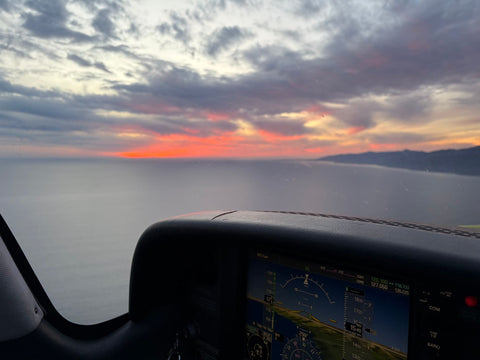
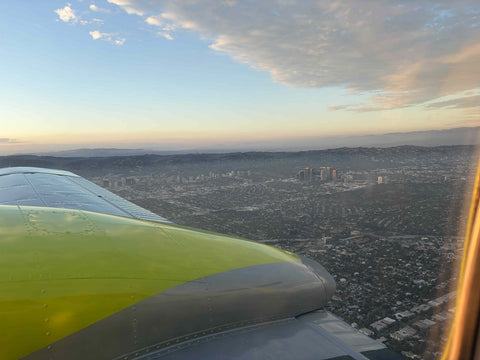
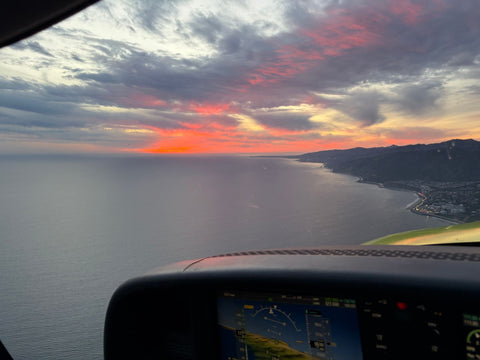
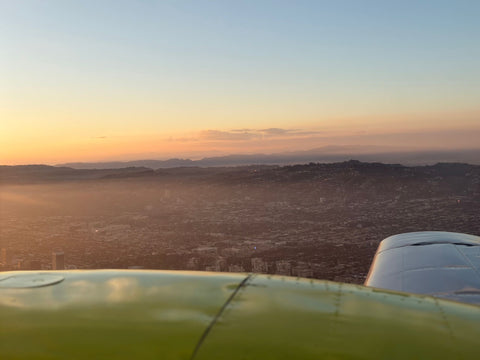
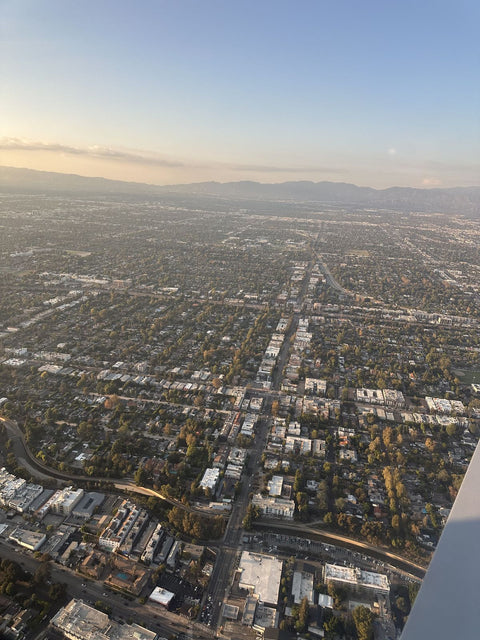
From late spring through summer, low stratus often sits over the basin in the morning and lifts during the day; our flyable days guide sets out the pattern. On those mornings the approach at Van Nuys is real.
The current FAA Terminal Procedures list five instrument approaches at Van Nuys: ILS Y RWY 16R, ILS Z RWY 16R, LDA-C, VOR-A and VOR-B. The two ILS procedures are the straight-in approaches, to the long runway. The other three carry a letter instead of a runway number, and the AIM explains that a letter in the title means circling-only minimums. So at Van Nuys the rule comes in two forms: the decision at DA on the ILS, and the circling rules on the lettered procedures.
For circling, paragraph (e)(2) adds a rule: if an identifiable part of the airport is not distinctly visible during a circling maneuver at or above MDA, you must go missed, unless losing sight of it is only caused by the airplane's normal bank during the circle. Read minimums from the current chart every time, never from memory or a web page.

We teach the decision first in the full-motion simulator, where an instructor sets the cloud base exactly at minimums and repeats the last minute until the call is automatic; our instrument rating course includes 20 hours in it. Then in the airplane, on real marine-layer mornings.
Self-Check
Eight scenarios: continue or go missed? The answer follows each one.
-
At DA you see the approach lights but no red bars. Visibility and position are good.
- Continue all the way to landing on the approach lights
- Continue, but only to 100 feet above touchdown zone elevation unless you see another reference
- Go missed immediately
Approach lights alone take you only to 100 feet above TDZE without the red bars.
-
At DA the runway lights are in sight, but flight visibility is clearly below the published minimum.
- Continue and land
- Go missed
Condition (c)(2) fails.
-
At MDA you see the threshold markings, but landing would need a steep dive.
- Continue and land
- Go missed
Condition (c)(1) requires a normal rate of descent using normal maneuvers.
-
Circling at MDA, the airport hides under the wing only because of your normal bank.
- Continue circling
- Go missed
Paragraph (e)(2) excepts a loss of sight caused only by normal bank.
-
Circling at MDA, cloud hides every identifiable part of the airport.
- Continue circling on your best guess
- Go missed
Paragraph (e)(2) requires an immediate missed approach.
-
At DA the runway's PAPI is distinctly visible. Visibility and position are good.
- Continue and land
- Go missed
A visual glideslope indicator is reference (vi).
-
You reach the missed approach point at MDA with nothing in sight.
- Hold MDA a little longer and keep looking
- Go missed
Paragraph (e)(1): the conditions must be met on arrival at the missed approach point.
-
At DA the runway end identifier lights are flashing ahead. Visibility and position are good.
- Continue and land
- Go missed
Runway end identifier lights are reference (v).
Book A Free Consultation Call Or Text (818) 330-1318
Frequently Asked Questions
What Is The 100-Foot Rule In 91.175?
With only the approach lights in sight, you may descend no lower than 100 feet above touchdown zone elevation unless the red terminating bars or red side row bars are also visible. Below that you need one of the other nine references.
Does Reported Visibility Or Flight Visibility Decide?
For Part 91, paragraphs (c) and (d) use flight visibility, what you can see from the cockpit. Reported visibility still matters for planning and for deciding whether to fly the approach at all.
How Does EFVS Change The Rule?
Paragraph (c) begins "except as provided in § 91.176," the enhanced flight vision system section. AC 61-65K describes EFVS operations to 100 feet above touchdown zone elevation and to touchdown and rollout, each needing its own training. Without approved EFVS and that training, 91.175(c) is the rule.
Do Part 91 Pilots Have Takeoff Minimums?
Not under 91.175(f), which applies to Parts 121, 125, 129 and 135. Obstacle clearance is still your responsibility, and the AIM strongly encourages flying a departure procedure in poor conditions.
How Do RVR Values Convert To Miles?
The AIM table gives RVR 2400 as half a statute mile, RVR 4000 as three-quarters and RVR 5000 as one mile.
Book A Free Consultation Book A Discovery Flight · $229 Call Or Text (818) 330-1318
Related Reading
- Instrument rating written exam and ACS: how 91.175 shows up on the test.
- IFR currency requirements: staying legal to fly approaches after the rating.
- Instrument proficiency check: getting current again.
Sources: 14 CFR 91.175, Takeoff and landing under IFR; 14 CFR 1.1 definitions; Aeronautical Information Manual, paragraphs 5-2-9, 5-4-5 and 5-4-20; FAA-S-ACS-8C, Instrument Rating Airplane ACS; FAA Terminal Procedures, Van Nuys; AC 61-65K.