


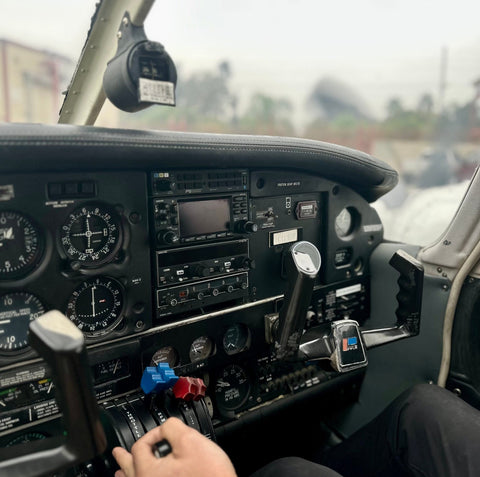
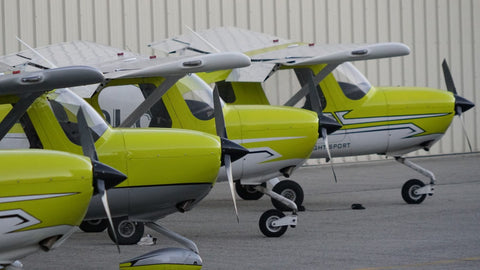


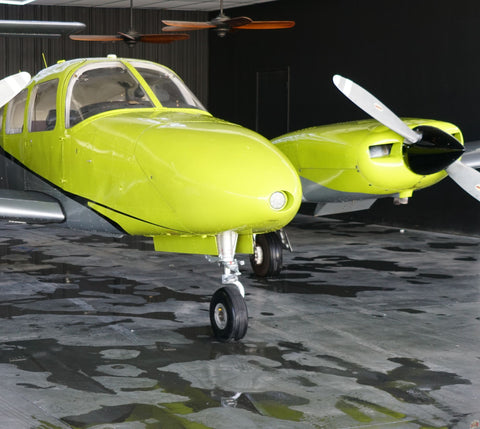

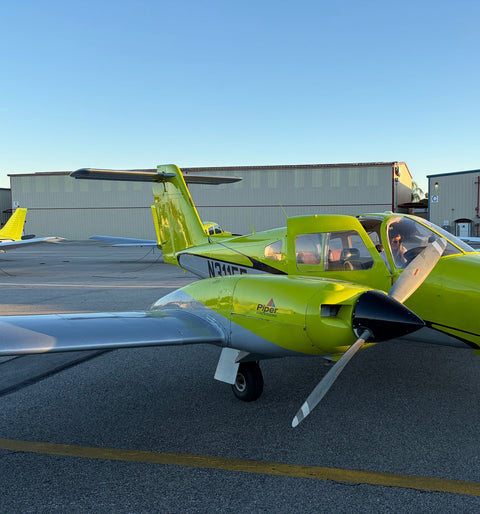














Our Airline Pilot Career Program costs $84,000 and covers every certificate and rating from zero experience through Private, Instrument, Commercial, Multi-Engine, CFI, CFII and MEI, over approximately nine months of full-time training, finishing at around 260 logged hours. Bought course by course the same certificates come to $58,229, and the difference buys hours, scheduling priority and the capacity to be held for you full-time.
This page is the cost breakdown. The stage-by-stage description of the training itself is on the airline pilot career program. Prices below are ours as of September 2026 and are the current figures.

What The $84,000 Covers
| Stage | What It Contains | Standalone Price |
|---|---|---|
| Private Pilot, Standard | 38 hours aircraft, 2 hours simulator, 30 hours dual, 3 hours ground | $10,400 |
| Instrument Rating | 20 hours aircraft, 20 hours simulator, 40 hours dual, 10 hours ground | $11,700 |
| Commercial Pilot | 30 hours aircraft, 20 hours simulator, 50 hours dual, 30 hours ground; 130 program hours | $15,400 |
| Multi-Engine Rating | 8 hours in the Seminole, 2 hours simulator, 10 hours dual, 2 hours ground; seven-day accelerated format | $5,100 |
| CFI, CFII and MEI | 20 hours single-engine, 8 hours multi-engine, 2 hours simulator, 30 hours dual, 50 hours ground | $15,400 |
| Total bought separately | Plus a $229 discovery flight to start | $58,229 |
| Airline Pilot Career Program | All of the above, approximately nine months, around 260 logged hours | $84,000 |
Books and materials are included in our packages. So is the Redbird TD2 desktop trainer.
Why The Package Costs More Than The Courses Added Together
This is the question anyone doing the arithmetic asks, and it deserves a straight answer rather than a sales line. The gap is $25,771, and it is three things.
Hours, Not Minimums
The individual course prices are built around the hours a well-prepared student typically needs for that one rating. The career program is built around arriving at roughly 260 logged hours with every rating in hand, which is more flying than the sum of the legal minimums for each certificate. 14 CFR 61.129(a) requires 250 hours for a commercial certificate, and a student who reaches it with exactly 250 and no margin has no room for a weak lesson, a failed stage check or a rating that takes longer than average.
Capacity Held For You
Full-time training means an aircraft and an instructor available to you most days for nine months. That is capacity we cannot sell to anyone else, and it is the single largest structural cost difference between a full-time program and part-time lessons. It is also the reason full-time students finish in fewer total hours: skills do not decay between flights.
Continuity Between Ratings
Seven practical tests in nine months requires the whole sequence to be scheduled as one plan rather than seven separate ones. Examiner availability, written tests, endorsements and aircraft type transitions all have to line up. Managing that is work, and it is priced in.
What Is Not Included, And What It Costs
Every honest price for flight training has an exclusions list. Here is ours.
| Item | Approximate Cost | Notes |
|---|---|---|
| FAA knowledge tests | Approximately $175 each, charged by the testing center | Private, instrument, commercial, fundamentals of instructing, flight instructor and flight instructor instrument |
| Examiner fees for practical tests | Roughly $800 to $1,000 each | Seven checkrides: private, instrument, commercial, multi-engine, CFI, CFII, MEI |
| FAA medical certificate | Charged by the aviation medical examiner | A first-class medical under 14 CFR 61.23 and Part 67 is required for airline transport pilot privileges |
| Headset | Varies widely | See our guide to pilot headsets for what to buy and when |
| iPad and app subscriptions | Varies | ForeFlight or similar, plus the tablet |
| Housing and transport | Varies | Relevant if you are relocating for nine months |
| Living costs during training | Varies | The largest excluded cost for most full-time students, and the one most often forgotten |
Seven examiner fees at $800 to $1,000 is $5,600 to $7,000, and six knowledge tests at approximately $175 is about $1,050. Budget somewhere around $7,000 to $8,000 of FAA and examiner costs on top of the program price, plus gear and living costs. Our page on the hidden costs of flight training goes through the whole list, and DPE checkride fees in Southern California covers examiner pricing and wait times specifically.

How To Compare Published Program Totals
Zero-to-airline totals published by other programs vary widely, and a headline number only means something once you know what sits outside it. Ours is $84,000 from zero experience, our own published price as of September 2026.
Two things matter when comparing totals. First, the exclusions differ. Depending on the program, examiners' fees and knowledge tests, an iPad, headset, flight bag and other pilot gear, third-party app subscriptions, and surcharges at selected training locations can all sit outside the headline price. Ours are listed, with figures, in the previous section. A price is not comparable until the exclusions are lined up next to it.
Second, the programs are not identical products. Compare what each includes hour for hour and rating for rating before comparing the totals, and ask every school you are considering the same questions about what happens if you need more hours than the plan assumes.
Not every airline-track program publishes a total. If a school's total is not published on its own website, treat that as information in itself.
The Cost Per Hour Behind The Package
If you would rather build your own path course by course, these are the rates that produce it. Every rate we publish is a package rate, for training inside a course.
| Aircraft Or Device | Package Rate |
|---|---|
| Cessna 162 Skycatcher | $179 |
| Piper Warrior PA-28-161 | $179 |
| Diamond DA20-C1 | $229 |
| Piper Arrow PA-28R | Part of the $15,400 commercial course |
| Piper Seminole PA-44-180 | Part of the $5,100 multi-engine package |
| Cirrus SR22 Turbo | $579 |
| Redbird MCX full-motion simulator | $120 |
| Redbird TD2 desktop trainer | Included with packages |
| Flight instruction | $110 per hour |
| Ground instruction | $110 per hour |
Work the arithmetic yourself and the package logic becomes obvious. Two hundred and sixty hours of single-engine time at the $179 package rate is $46,540 before a single hour of instruction, and instruction at $110 an hour across the dual requirement adds tens of thousands more. Whatever route you choose, the hourly rates are where the money actually goes.
The Simulator Is Not A Discount, It Is A Credit
The Redbird MCX is an FAA-approved advanced aviation training device, and time in it counts toward certificates within the limits the regulations allow: up to 50 creditable hours toward the Commercial certificate, and 20 of the 40 dual instrument hours for the Instrument rating. At $120 an hour inside a package against $179 for the cheapest airplane, that is a real saving on a real requirement rather than a marketing device. It is also where engine failures, partial panel and holds get flown properly, because the instructor can freeze the aircraft and reposition it.
What You Still Have To Pay For After The Program
The $84,000 takes you to roughly 260 hours with every rating through MEI. An unrestricted airline transport pilot certificate requires 1,500 hours under 14 CFR 61.159, and the gap is about 1,240 hours.
You do not pay for those. You are paid for them, which is the entire point of finishing with instructor certificates rather than stopping at commercial. Building 1,240 hours at the $179 package rate would cost $221,960; being paid to instruct them costs nothing and earns something. Our page on time-building jobs for new commercial pilots covers instructing and the other routes — banner towing, pipeline patrol, survey, jump flying, Part 135 and ferry work — and which parts of the logbook each one fills.
Reduced minimums of 750, 1,000 or 1,250 hours exist under 14 CFR 61.160 for military pilots and holders of qualifying aviation degrees. We are a Part 61 school and do not issue degrees, so plan on 1,500 unless you already hold one.
How People Pay For It
- Interest-free direct payments with us over up to 12 months.
- Stratus Financial over up to 15 years from $2,500 down, starting with a soft credit check.
- Scholarships against part of the cost. Our aviation scholarships page lists the current funds, amounts and deadlines.
- Paying stage by stage, buying one course at a time at the standalone prices. Slower and less efficient in hours, but it spreads the commitment.
Two things we do not do, stated plainly because they affect people's plans: we are a Part 61 school and not Part 141, we do not issue I-20s for student visas, and we do not accept the GI Bill. Our page on flight school loans covers the financing options in more detail.
What The Money Buys At The Other End
The US Bureau of Labor Statistics reports a median annual wage of $232,140 for airline pilots, copilots and flight engineers and $123,220 for commercial pilots in May 2025 wage data, with the occupation projected to grow 7 percent from 2025 to 2035. In California the airline pilot median is $353,900 and the commercial pilot median is $165,590, from 2025 BLS wage data as published by O*NET OnLine. All read 13 September 2026.
Published first-year first officer rates at the majors are lower than those medians by a wide margin: $125.52 per flight hour at United on rates effective 1 January 2026, and $118.00 and $113.00 at Delta and American per Air Gazette's comparison of 2 June 2026 citing Airline Pilot Central's January 2026 tables. Budget for a low first year, because the pay curve in this career is flat for two or three years and then steep. Our best-paying airlines for pilots page sets out the whole curve.
Questions To Ask Any School Quoting A Zero-To-Airline Price
- How many flight hours does the price include, and what happens if I need more? A price built on legal minimums is not a price, it is a deposit.
- Which certificates and ratings are in it? Some published totals stop at commercial and exclude the instructor certificates, which changes everything about how you build hours afterwards.
- What is excluded? Examiner fees, knowledge tests, medical, gear and living costs. Get the list in writing.
- Is an aircraft and instructor guaranteed available to me full-time? This is the difference between nine months and two years.
- What is the refund position if I stop? Ours is on our refund and enrollment policy page.
- Are there location surcharges? Some programs charge more at selected training locations. Get the figure in writing.
Related Reading
- The airline pilot career program — the training itself, stage by stage.
- How much does flight school cost — every certificate priced individually.
- The hidden costs of flight training — the exclusions list in full.
- Career change to pilot — the plan at 30, 40 and 50.
- Time-building jobs for new commercial pilots — how the last 1,240 hours get paid for.
- Flight school loans — how people finance $84,000.
- Pilot academies in Los Angeles compared — the four career-program models and what each one risks.
Airline Pilot Program Cost FAQ
How Much Does An Airline Pilot Program Cost?
Ours is $84,000 from zero experience through Private, Instrument, Commercial, Multi-Engine, CFI, CFII and MEI, over approximately nine months and around 260 logged hours. Totals published by other programs vary widely and exclude different things, so line up what each one includes, hour for hour, before comparing the headline figures.
What Does The $84,000 Include?
Every certificate and rating through MEI, the flight and ground instruction that goes with them, simulator time in the Redbird MCX and TD2, and books and materials. It covers roughly 260 logged hours rather than the legal minimum for each certificate.
What Is Not Included In The Price?
FAA knowledge tests at approximately $175 each, examiner fees of roughly $800 to $1,000 for each of seven practical tests, the FAA medical examination, headset and gear, iPad and app subscriptions, and housing, transport and living costs. Budget around $7,000 to $8,000 of FAA and examiner costs on top of the program price.
Why Is The Package More Than The Courses Added Together?
Bought separately the same certificates are $58,229 including a discovery flight. The $25,771 difference covers more flying than the sum of the individual course minimums, full-time aircraft and instructor capacity held for you across nine months, and the scheduling work of running seven practical tests in sequence.
Can I Pay For It One Rating At A Time?
Yes. Private is $10,400, Instrument $11,700, Commercial $15,400, Multi-Engine $5,100 and the CFI, CFII and MEI program $15,400. It spreads the commitment but usually takes longer and costs more in total hours, because skills decay between lessons.
Does The $84,000 Get Me To 1,500 Hours?
No. It gets you to roughly 260 logged hours with every rating through MEI. The remaining 1,240 hours toward the 1,500 required by 14 CFR 61.159 are normally built while being paid to instruct, which is why finishing with instructor certificates rather than stopping at commercial matters so much.
How Can I Finance An $84,000 Flight Training Program?
Interest-free direct payments with us over up to 12 months, or Stratus Financial over up to 15 years from $2,500 down with a soft credit check. Scholarships can be applied against part of the cost. We are a Part 61 school, we do not issue I-20s and we do not accept the GI Bill.
How Long Does The Program Take?
Approximately nine months of full-time training. Part-time, the same certificates take two to four years depending on how often you fly, which costs more in total hours and delays every year of seniority at the far end.
Is It Cheaper To Train Somewhere Other Than Los Angeles?
Hourly rates vary by region, but so does the number of days you can actually fly. Southern California weather supports a consistent schedule, and consistency is what keeps total hours down. Compare the all-in cost of finishing, not the headline hourly rate.
What Will I Earn After The Program?
Not the medians you will read about, not at first. Published year-one first officer rates at the majors are $125.52 an hour at United and $118.00 and $113.00 at Delta and American. The US Bureau of Labor Statistics median for airline pilots is $232,140 and for commercial pilots $123,220, both May 2025 wage data. The curve is flat for two or three years and then steep.
Get The Real Number For Your Situation
The right price for you depends on whether you already hold a certificate, whether you can train full-time, and what your medical situation is. A 60-minute discovery flight is $229, you fly it from the left seat with an instructor beside you, and it is credited in full toward training if you enroll within 24 hours. To get a written plan with every line item on it, book a free consultation or call (818) 330-1318 any day between 9 AM and 9 PM. We are at 7900 Balboa Blvd, Main Terminal Unit 108, Van Nuys, CA 91406, at Van Nuys Airport.